
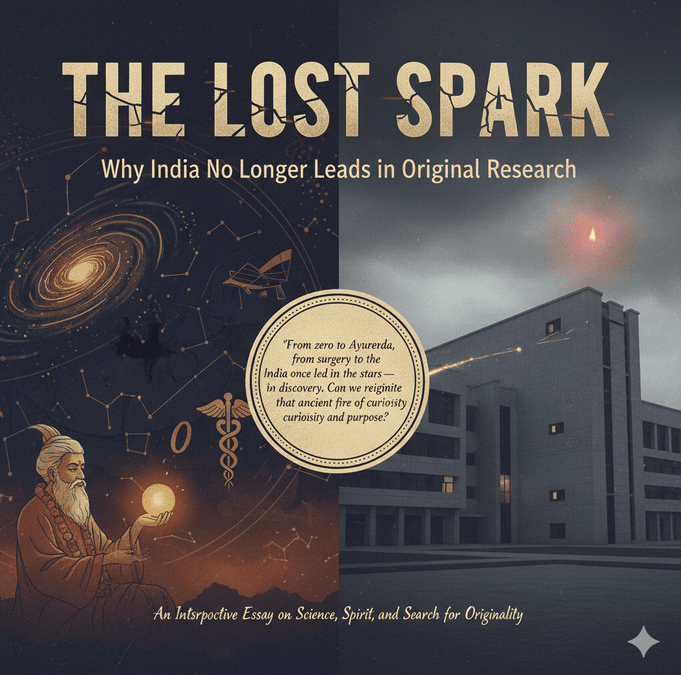
Once, India was not merely a geography — it was a state of mind. A land where thought itself was an experiment, where knowledge was not imported but born from the soil. From the concept of zero to the surgical brilliance of Sushruta, from the cosmology of Aryabhata to the Ayurvedic system of Charaka, inquiry was not an occupation but a way of life. We studied the stars to understand our destiny, dissected the human body to heal the spirit, and explored consciousness as rigorously as matter.
Today, we stand in an age where “research” in India too often means re-search—searching again through what others have already found. We assemble, integrate, reproduce, variate, innovate— but rarely originate. The laboratories are equipped, the data is abundant, the youth are intelligent — and yet, the creative fire that once blazed in Takshashila and Nalanda flickers in the shadow of dependence.
What changed? The answer is not merely in history, but in mindset. Colonialism did not just loot India’s wealth; it colonised her imagination. The British dismantled the indigenous systems of knowledge — the gurukuls, the ashrams, the dialogue between science and spirituality — and replaced them with an education designed for clerks, not creators.
The post-independence era, despite its initial vision, largely perpetuated this framework. Our universities became factories of degrees rather than crucibles of discovery. The bureaucratic control of science, with its grants, hierarchies, and approvals, suffocated the daring spirit that genuine research demands. In India today, the safest way to survive in academia is to conform — not to question.
The irony is painful. The civilisation that once measured the motion of planets with the naked eye now awaits Western satellites to tell it when the monsoon will come. The culture that once explored consciousness through meditation now seeks validation through Western psychology. The nation that built step-wells and sustainable irrigation systems now suffers from water stress. We once built homes that cooled themselves; now we import air-conditioners.
The tragedy of Indian science is not the lack of talent but the misdirection of it. We have become assemblers of Western thought, integrators of borrowed technology, imitators of innovation. Our brightest students aspire to leave — and when they stay, they spend their best years fighting paperwork, nepotism, or the fear of ridicule for thinking differently. Original research begins with an uncomfortable question — “Why?” But our system rewards the comfortable answer — “Because that’s how it’s done.”
This intellectual timidity has cost us dearly. Consider the paradox: a nation of 1.4 billion people, with over 1,000 universities and the world’s third-largest scientific manpower, still struggles to ensure clean drinking water. Our soil carbon levels are plummeting, turning once-fertile fields into dust bowls. Our crops gasp for water in a country historically known for water wisdom. We import fertilisers to grow food on land once nourished by nature’s cycles.
We built a digital India, but not a scientific India. Our obsession with coding has outpaced our understanding of chemistry; our fascination with AI has eclipsed our attention to agriculture. We have turned science into a service industry.
Science without purpose is machinery without a soul. True research arises not from the desire to publish, but from the hunger to solve — to bring light to human suffering, to make life more harmonious. Somewhere along the line, Indian science lost this moral compass.
Our institutions measure success in impact factors, not in impact on people. A young researcher spends more time formatting citations than formulating hypotheses. The scientist in India today is not free — not intellectually, not economically, not spiritually.
The global scientific race is no longer about who knows more, but about who asks better questions. And questions, by their nature, require the courage to look within — to confront failure, to dissent, to imagine anew. That courage was once the essence of Indian inquiry. It is now outsourced.
It is not nostalgia to remember that India once saw science as a form of sadhana — a disciplined pursuit of truth. Sushruta did not dissect bodies for vanity; he sought to relieve suffering. Aryabhata did not map the heavens for profit; he was mapping the order in chaos. Ancient Indian science was rooted in ethics, aesthetics, and ecology. Knowledge was sacred because it was in the service of balance — between body and mind, human and nature, matter and spirit.
The West advanced by separating the observer from the observed. India advanced by realising that the two were one. This holistic worldview is precisely what the modern planet — fractured by climate change, pollution, and mental crisis — is searching for. Yet we have abandoned it.
If we revived the spirit of our ancestors, we could lead again in planetary health, regenerative agriculture, biomimetic materials, and conscious AI. The answers to the future lie encoded in our past — in Ayurveda’s systems thinking, in Vedic mathematics’ pattern recognition, in the yogic science of the mind.
To rebuild India’s research soul, we must begin by reforming not institutions, but intentions. We need a new philosophy of science — one that marries rigour with relevance, imagination with integrity.
-
- Freedom to Fail: Innovation demands risk. Our scientists must be allowed to fail without fear of punishment. Great discoveries come from repeated defeats, not guaranteed results.
- Purpose-Driven Research: Redirect funding from vanity projects to value creation — clean water, soil regeneration, nutrition, affordable health, and renewable energy.
- Interdisciplinary Education: Dissolve the walls between physics and philosophy, biology and ethics, technology and ecology. The best ideas arise where boundaries blur.
- Local Laboratories, Global Vision: Encourage rural research labs, village innovation centres, and citizen science initiatives that address local challenges — from fluoride in groundwater to farm waste recycling.
- Cultural Confidence: Teach our youth that knowledge is not Western property. Let them read both Newton and Nagarjuna, both Einstein and Patanjali.
When a student in a small town can connect her grandmother’s herbal wisdom to a modern biochemistry lab, India’s scientific renaissance will begin.
Mahatma Gandhi once spoke of Swadeshi not merely as self-reliance in cloth, but as self-respect in thought. Today, India needs a Swadeshi of the Mind. We need to reclaim the audacity to think originally, to question received truths, to innovate from empathy rather than envy.
We must remind ourselves that science is not a Western invention — it is a human instinct. The child who asks why is already a scientist. Our role as a civilisation is to nurture that question, not silence it.
The Vedic rishis did not have billion-dollar grants or supercomputers. What they had was a reverence for inquiry. They looked at the sky and asked, “What holds it up?” They looked at themselves and asked, “Who am I?” Out of those questions came astronomy and philosophy, medicine and mathematics — and a civilisation that revered both
India’s future will not be secured by imitation. It will be shaped by imagination. We cannot import curiosity, nor outsource creativity. We must return to that sacred laboratory within — the chitta where thought becomes insight.
Let us build a new generation of thinkers who see the divine in discovery, the moral in mechanism, the poetry in proof. Let us make science once again an act of service, not status. The lamp of original research has not died — it waits to be lit again. And when it does, India will not just catch up with the world; it will illuminate it.
Very informative and thought provoking article
The idea of a “Swadeshi of the Mind” beautifully reminds us that true self-reliance begins with original thinking and cultural confidence.
Excellent, thanks a lot for depicting in such a nice way
Great article! quite insightful and enriching. We really need to have swadeshi scientific mindset and not prevailing colonial one.
Very insightful and informative. I support the fact that we should not just do re-search but ask uncomfortable questions to discover new information.
Good on Sanjay Kumar ji. This reminds me our in depth conversations about research scenario when I spent one year at CSIR complex, Palampur. Keep spreading positive and original ideas. Cheers.
An excellent blog..nicely-worded and inspiring. My compliments
Valuable reflections that rekindle our pride in ancient Indian vision, floating once on the wings of excellence, thoughtful and creative zeal, to explore nature and it’s laws.
Free thinking is basic for creativity – the outcome simply benefits entire humanity, not merely a nation alone. This nation and its citizens has that (inherent) capacity; only that the system needs re-wiring.