India’s nutrition story is often told as a battle against hunger. However, the deeper—and still unsolved—battle is against hidden hunger: widespread micronutrient deficiencies that persist even when stomachs are filled. Among the poorest households, the diet can be cereal-heavy, protein-light, and thin in micronutrient density, producing a chronic mismatch between calories and capability. The national data are sobering.
According to the National Family Health Survey-5 (NFHS, 2019–21), under-5 malnutrition remains high—stunting at about 35.5%, wasting at 19.3%, and underweight at 32.1%. At the same time, anemia—a sensitive marker of dietary quality, infection burden, and micronutrient gaps—affects 67.1% of children aged 6–59 months and 57% of women aged 15–49 years. The result is not a small “pocket problem”; it is a widespread condition that quietly undermines school performance, work capacity, maternal outcomes, and healthy aging.
Within this landscape, vitamin B12 deficiency deserves special attention because it is both common and structurally “hard” to solve through conventional agriculture alone. Unlike iron or zinc, B12 is not made by plants; it is synthesized de novo only by certain microbes. India’s largely plant-forward eating patterns, coupled with low intake of animal-source foods among the poor, make B12 inadequacy a recurring risk across life stages.
The Comprehensive National Nutrition Survey (CNNS 2016–18) provides a rare, biomarker-based national window: it reported vitamin B12 deficiency in 14% of children aged 1–4 years, 17% of children aged 5–9 years, and 31% of adolescents aged 10–19 years. CNNS also shows that vitamin D deficiency is not confined to affluent urban lifestyles: it is found in 18% of children aged 5–9 years and 24% of adolescents aged 10–19 years. The combined picture is clear: India’s problem is not merely insufficient food—it is inadequate nutritional power in everyday staples.
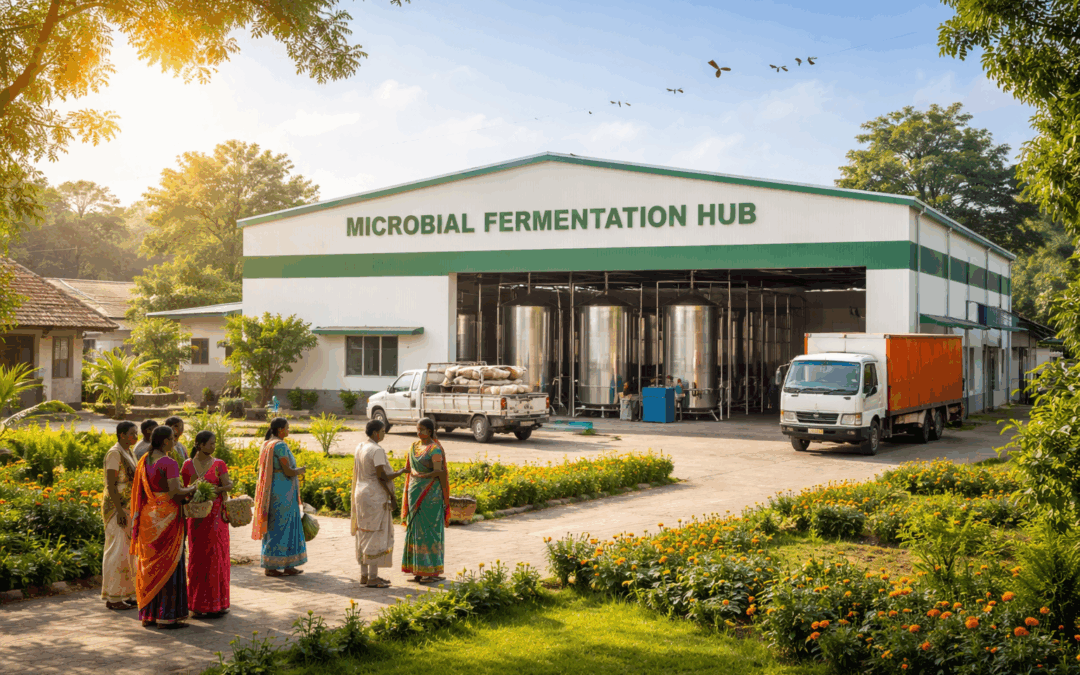
This is where a NextGen Biology idea becomes compelling: view vitamin B12 not as an occasional “tablet problem,” but as a national nutrition input produced with the same rigor as vaccines, enzymes, or essential medicines—then distributed through public programs at scale. The key idea is microbial fermentation hubs: regionally spread biomanufacturing facilities that produce food-grade vitamin B12 (usually as cyanocobalamin or other standardized forms used in fortification) and supply it into the premix and fortified staple ecosystem that supports India’s large public delivery systems.
A fermentation hub is not a single tank and a lab; it is an integrated technology stack. It starts with a strain platform—microbial producers that can synthesize cobalamin efficiently and consistently—maintained as master and working cell banks, with strict controls to prevent genetic drift and contamination. It then moves into a seed train and production fermentation in controlled bioreactors where oxygen, pH, temperature, micronutrients (including cobalt), and feed strategies are tuned to maximize yield while preserving reproducibility batch after batch.
Although the specifics differ between organisms and processes, the modern hub depends on instrumentation and automation: dissolved oxygen probes, foam control, sterile aeration, CIP/SIP (clean-in-place/sterilize-in-place), and increasingly data logging, which enables early detection of deviations. In public nutrition, “average yield” is less significant than “reliable potency,” because a national program cannot risk supply shocks or fluctuations in vitamin content.
Downstream processing is equally decisive. B12 in a fermentation broth is embedded in a complex mixture of cells, proteins, and metabolites; it must be separated, extracted, purified, concentrated, and stabilized into a form suitable for premixes and fortified foods. The hub, therefore, includes filtration/centrifugation, extraction steps, and purification workflows that meet food-grade standards, followed by drying and packaging designed for Indian heat and humidity. Here, NextGen Biology meets old-school chemical engineering: the win is not only higher titers but also lower losses and higher stability downstream, because cost per microgram is shaped as much by recovery and shelf life as by upstream productivity.
Quality assurance is the heart of the system—because public trust is the currency of public nutrition. India already has a framework and method ecosystem for fortification standards under FSSAI, and B12 can be directly anchored to those methods and compliance routines. The Food Safety and Standards Authority of India (FSSAI) has published specific analytical methods for determining vitamin B12 (cyanocobalamin) in Fortified Rice Kernel (FRK), including LC-MS/MS-based methods, as well as methods for vitamin-mineral premixes. In practice, a hub-based model can align to these protocols: every B12 lot is released only after potency confirmation, impurity checks, microbial safety validation, and stability testing, then digitally traced from microbe to meal. This creates a “chain of evidence” across the supply chain.
The most compelling aspect of this vision is its alignment with India’s public nutrition channels. India already operates extensive systems—TPDS, ICDS, and PM POSHAN—that consistently reach the poor, and these strategies increasingly incorporate fortified staples. FSSAI’s fortification regulations explicitly include vitamin B12 in standards for certain foods. Therefore, a fermentation hub does not need to build a new distribution system; it must become a dependable upstream supplier to premix manufacturers, FRK producers, flour millers, and state procurement systems. In the rice fortification ecosystem, this arrangement creates a scalable pathway to reach poor households nationwide.
The infrastructure logic follows a "hub-and-spoke" structure. A hub produces high-quality B12 at scale; spokes are premix manufacturers, FRK producers, flour millers, and state systems. The advantage of hubs is cost, resilience, and predictability: regional production reduces import dependence and currency volatility while enabling rapid response to demand spikes. When anemia remains stubborn—67.1% in young children and 57% in women (NFHS-5)—interventions must be systematic, not seasonal. Hubs convert micronutrients into a managed supply chain rather than a fragile market commodity.
This vision also acknowledges a crucial reality: B12 deficiency is only one thread in a larger fabric of deprivation. The same populations often carry multiple burdens—iron deficiency, folate gaps, infections, low dietary diversity, and poverty. CNNS shows significant B12 and vitamin D deficiencies in adolescents, the group shaping future maternal health and workforce capacity. Hence, the goal is not “a B12 project” but a scalable nutrition manufacturing backbone, capable of expanding to other fortification-grade nutrients and fermentation-derived ingredients, with rigorous measurement and feedback loops.
The most challenging aspect is governance, not bioreactors. A hub network succeeds only if four elements are non-negotiable:
(1) Standards based on validated analytical methods.
(2) Transparent procurement and long-term offtake agreements.
(3) Independent testing capacity.
(4) Outcome monitoring using biomarker improvements.
India already possesses many building blocks of this system. The task ahead is to integrate them into a resilient national nutrition capacity—a nutrition supply chain designed, audited, and continuously refined like critical infrastructure.
— Dr. Sanjay Kumar, Prof. Arun Tiwari