Village Republic 2.0: Reimagining Rural Prosperity for a New World
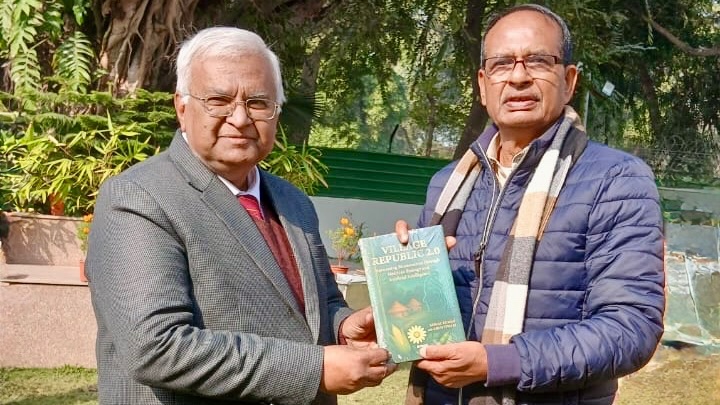
There are moments in history when ideas separated by decades suddenly converge, illuminating a path that feels at once ancient and astonishingly modern. Village Republic 2.0 is born from such a moment. It tells the story of a scientist—Dr Sanjay Kumar, a plant physiologist whose journey from the lab bench to the frontlines of science administration mirrors India’s evolution into a knowledge-powered nation. Yet the book is not just a biography. It is a manifesto for the world, a call to redesign the future by harnessing the most abundant yet least valued resource on Earth: rural human ingenuity.
A century ago, Mahatma Gandhi dreamed of a self-reliant rural economy, where every village was a complete republic—economically vibrant, socially cohesive, ecologically secure. At the dawn of the new millennium, Dr A.P.J. Abdul Kalam carried this dream forward, envisioning Providing Urban Amenities in Rural Areas (PURA), so that no young person would have to leave their village to fulfil their potential. Today, in an age shaped by Artificial Intelligence, NextGen biology, and climate crises, these visions find their practical synthesis in Village Republic 2.0.
Dr Sanjay Kumar’s life becomes the lens through which this story unfolds. From decoding the stress physiology of Himalayan plants to building ecosystems for national biotechnology missions, he represents a new breed of Indian scientist—rooted in the soil, trained in the laboratory, sharpened by global science, and driven by a moral imperative to uplift the marginalised. His journey shows that science is not merely a pursuit of knowledge but a vehicle for justice, prosperity, and nation-building.
When Mahatma Gandhi spoke of self-reliant villages, he was not proposing isolation—he was proposing empowerment. For him, India’s strength lay not in copying Western industrial models but in designing systems grounded in its own bioresources, biodiversity, and civilisational values. The village, he believed, could be the unit of transformation—not a relic of the past but a seed of the future.
Dr Kalam’s vision of PURA infused this foundation with modern science. Connectivity, education, entrepreneurship, and physical infrastructure became its four pillars. He often said that the next revolution would be “knowledge-based and rural-centric,” powered by technology yet guided by compassion.
Village Republic 2.0 unites these two visions and offers something even more powerful: a blueprint for turning rural bioresources into global value chains using NextGen Biology, AI, and deep-science innovation.
For decades, low-income rural communities have been viewed through the lens of deficiency—low yields, low incomes, low education, low technology. But the real problem was never scarcity; it was the absence of scientific processing, value addition, and market access.
India is one of the world’s wealthiest nations in biological diversity. Every village grows something unique—medicinal herbs, aromatic plants, high-value grains, fruits, fibres, legumes, and flowers. Each bioresource carries genetic intelligence shaped by millennia of evolution. Yet most of it is sold raw, with nearly 90% of the value captured elsewhere.
Village Republic 2.0 flips this equation. It shows how molecular biology, genome editing, phenotyping, metabolomics, and AI-driven analytics can unlock hidden value in plants cultivated for generations. Modern bioprocessing turns leaves into nutraceuticals, roots into cosmetics, flowers into essential oils, and residues into bio-based materials. AI maps soil health, optimises cultivation, predicts yields, and enables precision farming, while drones and sensors bring laboratory-level insight to open fields.
The book places Dr Sanjay Kumar at the heart of this transformation. From his work at the CSIR–Institute of Himalayan Bioresource Technology to his role as a national science administrator, he has spent decades building bridges between research laboratories and remote villages. His science is world-class; his commitment to ensuring that the poorest benefit from the deepest science is what makes it transformative.
He believes that when a plant is understood at the molecular level, its economic potential multiplies. A medicinal plant becomes a global product. A wild herb becomes a patented molecule. A local fruit becomes an international brand. A small village becomes a hub of bio-entrepreneurship.
In Village Republic 2.0, science becomes the great leveller—an instrument of dignity, empowerment, and abundance. The book is not merely visionary; it is an actionable roadmap for policymakers, scientists, entrepreneurs, students, and citizens. It invites readers to imagine India not just as a fast-growing economy, but as the architect of a new civilisation—where technology, ecology, and human aspiration harmonise.
In celebrating Dr Sanjay Kumar’s journey, the book celebrates the latent genius of every village, every farmer, every young mind. It reminds us that abundance is not a distant dream—it is a design choice. If Gandhi lit the first lamp, and Kalam carried the flame into the new millennium, Village Republic 2.0 shows how India can use that light to guide the Global South out of poverty, inequality, and environmental collapse.
This is more than a book.
It is a call.
A promise.
A metamorphosis in the making.
And it begins in the quiet dignity of a village—where the future of the world will be written.