There are places where geography produces beauty, and there are places where it produces thought. Palampur, nestled in the Kangra Valley under the watchful presence of the Dhauladhar ranges, belongs to the latter. The very name—derived from pulum, meaning “abundant water”—hints at a deeper fertility, not just of soil but of ideas. In the late nineteenth century, this abundance first found expression in tea. Kangra tea travelled far beyond these hills, reaching London, Barcelona, and Amsterdam, quietly carrying with it the imprint of a small Himalayan town that understood how to nurture value without spectacle.
Yet Palampur did not follow the trajectory of many such places, consumed by their own success. It remained, for a long time, understated and inward-looking. The narrow-gauge railway that once connected it to the plains was built not for tourism, but for the purpose of transporting machinery for the Uhl Hydroelectric Project. Life moved slowly. There were few buses, almost no taxis, and even fewer distractions. But it is often in such quiet that deeper transformations begin. Today, even as modern infrastructure expands—symbolised by the airport's growing reach—Palampur’s true evolution lies elsewhere. It has emerged, almost organically, as a rare and powerful confluence of science, agriculture, and ecological intelligence.
At the heart of this transformation is a remarkable clustering of institutions that collectively define the region's intellectual character. The CSK Himachal Pradesh Krishi Vishvavidyalaya anchors the landscape with its focus on hill agriculture, shaping generations of scientists and farmers who understand the delicate balance of mountain ecosystems. Complementing it is the CSIR-Institute of Himalayan Bioresource Technology, a laboratory that looks both inward and outward—into the biodiversity of the Himalayas and toward global challenges of sustainability, health, and climate resilience. Alongside them, the ICAR-Indian Grassland and Fodder Research Institute and the ICAR-Indian Veterinary Research Institute form a unique scientific ecosystem, where crops, fodder, livestock, and the environment are not treated as separate domains, but as interconnected realities.
What makes this cluster truly distinctive is not merely its presence, but its orientation. The science that emerges from Palampur is not abstract or removed; it is deeply rooted in the needs of the land and the people it serves. Consider the case of heeng—asafoetida—a staple of Indian kitchens that, for decades, remained entirely dependent on imports. Through sustained effort, scientists at IHBT enabled its cultivation in Indian conditions, with successful trials in the cold deserts of Lahaul and critical breakthroughs in Palampur itself. This is not just an agricultural success; it is a quiet act of strategic self-reliance. Similarly, the introduction of monk fruit, a natural zero-calorie sweetener, opens new economic opportunities for farmers while addressing emerging global health needs. Even the tulip gardens, which at first glance appear to be aesthetic indulgences, function as living laboratories, demonstrating how floriculture can become a viable livelihood in Himalayan terrain.
Underlying these scientific advances is a strong human foundation. With a literacy rate exceeding ninety per cent, Palampur sustains an intellectual culture that extends beyond institutional boundaries. It has been shaped by luminaries such as Virendra Lal Chopra, S. K. Sharma, C. L. Acharya, S. S. Johl, and Anupam Varma—figures who have carried the rigour of these hills into national and global agricultural thinking. Their work reflects a continuity of purpose: that science, when aligned with context, can become an instrument of both resilience and equity.
Benchmarking helps us locate excellence by comparison, but it also risks obscuring what is truly original. To call Palampur a “Himalayan Wageningen with a conscience” invites a brief explanation. Wageningen is a small Dutch town that hosts Wageningen University & Research—widely regarded as one of the world’s leading centres for agricultural science, food systems, and environmental sustainability. Often described as the “Silicon Valley of food,” it brings together cutting-edge research, industry collaboration, and policy influence to shape how the world grows and consumes food.
Seen in that light, the comparison highlights Palampur’s emerging potential—but also its distinctive character. For if Wageningen represents the pinnacle of technology-driven, globally networked agriculture, Palampur represents something more grounded and perhaps more necessary for our times: a “living laboratory of the Global South,” where knowledge is not extracted from the land but co-created with it. Here, innovation does not seek to dominate nature, but to align with it; it does not chase scale for its own sake, but pursues relevance, resilience, and continuity. If nurtured with clarity and intent, Palampur can emerge as **a beacon for a new scientific imagination—rooted yet forward-looking, rigorous yet humane—**demonstrating that the most enduring futures are not engineered in isolation, but grown in quiet harmony with the ecosystems they serve.
This larger idea finds a deeply human expression in my own journey. Arriving in Palampur in 1990 at the age of 27, I was a young PhD graduate from the Indian Agricultural Research Institute. I came to work at the CSIR-Institute of Himalayan Bioresource Technology—then still in the process of establishing its identity. What began as a professional assignment gradually became a life’s calling. Here, I found not only a scientific purpose but also my life partner, Richa. Over the years, I dedicated myself to helping shape what IHBT would become—one of India’s leading centres for Himalayan bioresource research. Even after retirement, my relationship with Palampur has remained strong. Now working with the Department of Agricultural Research and Education (DARE) in New Delhi, I still return to Palampur whenever I can, living in my home there, drawn back by an invisible thread to the landscape that has shaped both my science and my life.
Now in my mid-sixties, I find in Palampur my own Naimisharanya—that sacred forest of the Mahabharata, remembered as a hallowed space of knowledge, narration, and deep ecological awareness. It was in Naimisharanya that rishis gathered in an enduring ashram—not to dominate or declare knowledge, but to dwell in it, to listen, to refine, and to transmit it in quiet communion with nature. In that sense, it was perhaps the earliest laboratory—where the rishis, the scientists of their time, observed the rhythms of seasons, rivers, and living systems, and translated these insights into wisdom carried across generations through narrative, ethics, and lived practice.
It was here that Vaishampayana, the devoted disciple of Vyasa, narrated the sacred knowledge to Janamejaya—not as instruction imposed, but as presence shared. Knowledge, in that setting, was not an assertion of authority but an unfolding—received in stillness, shaped by reflection, and anchored in harmony with the world it sought to understand.
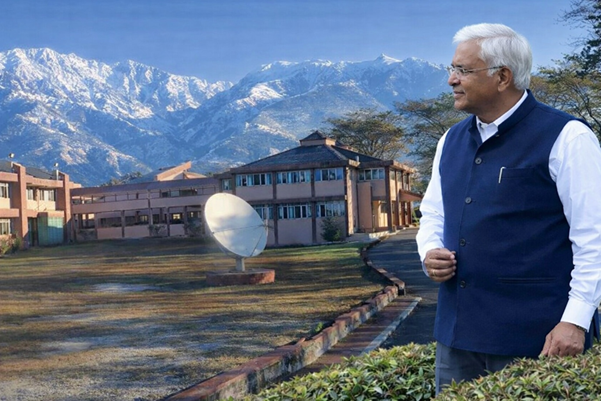
I sit outside my home in Palampur, my gaze resting on the majestic Dhauladhar Range, its silent peaks holding time in a way no clock can. Around me, life unfolds without announcement—the quiet intelligence of trees, the unhurried rhythm of wind, the subtle conversations of birds and unseen creatures. And then, as if to seal an unspoken understanding, a butterfly drifts in and settles gently on my shoulder. In that fleeting moment, there is no separation—only a quiet affirmation that I am no longer an observer here, but a participant; not an outsider studying nature, but one who has been, in some small way, accepted into its fold.
— Dr Sanjay Kumar with Prof. Arun Tiwari
It makes a fascinating reading and click a string in my memory. I was born in Palampur, and moved out just before my schooling began. The place, then merely a village, was much different; a few scattered clusters of houses, a robust network of natural water channels, and natural beauty in abundance. There was no motorable road to connect these dots of habitations, including the one to our house. As memories would reflect always more rosier, this town was one of my dream transcendence.
Fortunately, the town nurtured partly into a place of academic distinction, rightly said by the presence and contribution of many illuminaries, and by many more in their humble ways.
It’s valuable and all that can be expected, to begin with…..
Heartiest congratulations to Sanjay for the magnificent description of Palampur. It brings back the memories of quarter century back when I fell in love with the place during my first visit in August 2000. Since then Palampur is our home and people there our family. We love them all.
Our heartfelt thanks to Dr Shyam Kumar Sharma to make this happen and to all friends, particularly at the HB Bindraban and IHBT for their love and affection.
Dr. Sanjay Kumar and Prof. Arun Tiwari have beautifully captured the soul of Palampur—not just as a scenic town, but as a living, breathing hub of scientific thought and ecological harmony. This piece stands out for its depth, blending history, science, and personal journey with rare sensitivity. The idea of Palampur as a “living laboratory of the Global South” is particularly striking and relevant in today’s context of sustainable development. It reminds us that true progress lies not in blind industrial expansion, but in aligning innovation with nature. The comparison with Wageningen is insightful, yet Palampur’s grounded, humane approach makes it even more inspiring. The personal reflections add warmth and authenticity, making the narrative deeply relatable. Such writing not only informs but also inspires policymakers, researchers, and citizens alike to recognize and preserve the unique intellectual and ecological heritage of regions like Palampur.