In an era where adulteration, micronutrient depletion, and ultra-processed diets are silently fuelling India’s epidemic of diabetes, cardiovascular disease, immune dysfunction, and metabolic disorders, the search for scientifically validated, naturally nutrient-dense bioresources has become a public health imperative. Within this landscape, Box myrtle/bayberry (Myrica esculenta)—known widely as Kafal in the Himalayan belt—emerges not merely as a traditional wild fruit, but as a compelling new-age Indian nutraceutical with the potential to bridge nutritional deficits, rural livelihoods, and preventive healthcare.
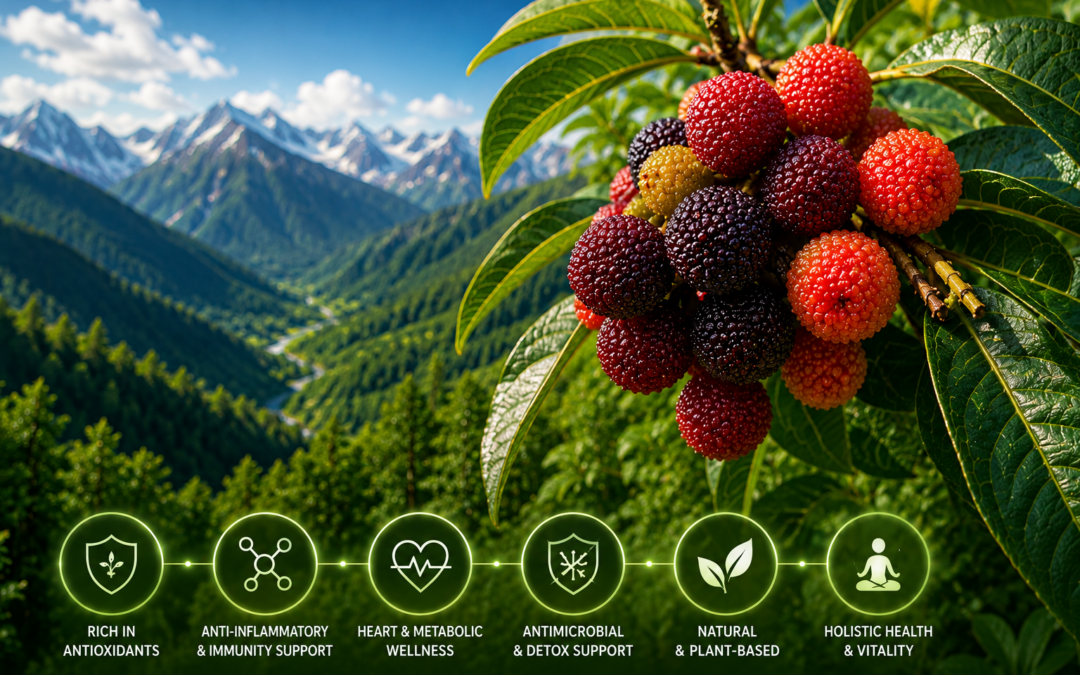
Native to the Indian Himalayan region, particularly Uttarakhand, Himachal Pradesh, Meghalaya, Arunachal Pradesh, and Nepal, Myrica esculenta has long been consumed by indigenous communities for both nourishment and medicinal value. Modern phytochemical research now validates this traditional wisdom. Studies have demonstrated that the fruit, bark, and leaves are rich in polyphenols, flavonoids, anthocyanins, quercetin, catechins, gallic acid, and potent antioxidants, compounds associated with reducing oxidative stress, improving inflammatory regulation, supporting cardiovascular resilience, and potentially mitigating chronic degenerative diseases. Its antimicrobial and anti-inflammatory properties further position it as a candidate for broader applications in functional foods and preventive medicine.
India today faces a paradox: calorie sufficiency often coexists with micronutrient poverty. Rampant adulteration, soil degradation, industrial farming practices, and nutrient dilution have created populations that may consume enough food yet remain deficient in essential protective compounds. This hidden hunger contributes to a cascade of irreversible disorders—from insulin resistance to neurodegeneration. Bayberry, with its dense bioactive profile, offers an opportunity to reposition nutrition from mere sustenance to cellular protection and metabolic restoration.
However, for Kafal to transition from an underutilised wild fruit to a mainstream nutraceutical, commercialisation must be rooted in rigorous scientific standardisation rather than folklore alone. This requires: controlled phytochemical profiling across geographies; standardised extraction and preservation technologies; clinical trials for dosage, efficacy, and safety; development of shelf-stable forms such as capsules, powders, concentrates, gummies, antioxidant beverages, and fortified supplements; and finally, FSSAI-compliant regulatory pathways for over-the-counter nutraceutical deployment.
A robust value chain could allow Kafal to be positioned similarly to globally marketed superfoods like elderberry, açai, or cranberry—natural resources that were once regionally obscure but, through scientific validation, branding, supply-chain sophistication, and nutraceutical innovation, evolved into multi-billion-dollar global industries. Products such as Sambucol (elderberry), Amazonian açai wellness brands, Ocean Spray cranberry, quinoa from the Andes, matcha from Japan, and turmeric-derived curcumin formulations from South Asia demonstrate how indigenous bioresources can transcend geography to become premium global health commodities. With similar scientific rigour, phytochemical standardisation, clinical validation, and strategic market positioning, Kafal could emerge not merely as a Himalayan fruit but as India’s flagship contribution to the international functional food and preventive wellness economy.
The socioeconomic implications are equally transformative. Marginalised Himalayan and tribal communities that traditionally harvest Kafal often remain excluded from high-value downstream markets. By integrating local populations into cultivation, sustainable wild-harvest management, primary processing, cooperative ownership, and decentralised nutraceutical manufacturing, India can create a bioeconomy model where biodiversity becomes livelihood security. This would not only incentivise ecological conservation of fragile mountain ecosystems but also convert neglected forest produce into structured income streams for rural populations.
In this sense, Kafal represents more than a fruit—it is a convergence point of preventive medicine, food technology, tribal enterprise, biodiversity conservation, and economic justice. If India chooses to invest in scientific validation, supply-chain modernisation, and nutraceutical entrepreneurship, Kafal could evolve from a seasonal wild harvest to a nationally recognised over-the-counter health resource.
The future of nutrition in India may well depend not only on producing more food, but on rediscovering and scientifically unlocking the forgotten biological wealth already growing in its mountains. Kafal stands as a powerful reminder that the next frontier in healthcare may lie not in synthetic intervention alone, but in transforming indigenous biodiversity into evidence-based wellness for millions.
But the central question remains: Who will do it? Who will aggregate scattered harvests from remote Himalayan slopes? Who will build the processing infrastructure, standardise phytochemical content, ensure regulatory compliance, develop trusted nutraceutical formulations, and market Kafal in India and worldwide? Wild bioresources do not become billion-dollar industries through discovery alone. They require institutional imagination.
India needs an “Amul for nutraceutical biodiversity” or a “Lijjat model for bioresource entrepreneurship”—a cooperative, science-backed, market-driven national movement capable of integrating tribal gatherers, farmer-producers, food technologists, biotech researchers, logistics experts, and consumer brands into a unified value chain. Such an enterprise must go beyond conventional agriculture and embrace the full architecture of modern bioeconomic innovation: procurement, preservation, processing, branding, export strategy, and preventive healthcare integration.
Nothing transformative has ever emerged from business as usual. In the modern Brave New World, innovation does not occur only in laboratories—it is ultimately validated, scaled, and made civilisationally relevant in markets. If India is serious about converting its neglected ecological wealth into global leadership in wellness, then entrepreneurial institution-building—not merely scientific discovery—will determine whether Kafal remains a forgotten mountain fruit or becomes the foundation of an entirely new nutraceutical revolution.
— Dr Sanjay Kumar, Prof. Arun Tiwari
In case you’re discovering services for direct video engagements, discovering the diverse details of livejasmin can be truly helpful. No matter if you’re looking at livejasmin_cams or the livejasmin_studio offerings, each one presents special options for audiences and creators respectively. For a thorough summary and some practical tricks, check out livejasmin_video for extra details.
Also, livejasmin_video and livejasmin-stream functions deliver fluid and superior viewing moments that elevate audience engagement. It pays to discovering these features to maximize your experience on the platform and benefit from uninterrupted streaming content.
Si llevas buscando una experiencia unica de alojamiento, las esferas en la peninsula son una opcion ampliamente conocida. Con opciones en burbujas Andalucia pasando por recintos burbuja en tierras catalanas y Madrid, estas estancias proporcionan una cercania singular con la entorno natural sin sacrificar a la comodidad total. Del mismo modo, rincones como Bardenas Reales y la habitacion burbuja Estrella Polar en Murcia se diferencian por su escenario singular y diseno vanguardista.
Para personas que estan interesados en conocer modalidades de turismo burbuja proximos a Madrid, Catalunya o Alicante, hay distintas opciones como casas burbuja, zonas de acampada burbuja y burbuja cabanas. Puedes facilmente ver amplia informacion y precios actualizados sobre burbujas experience en numerosas regiones a continuacion: cabanas burbuja cataluna . Sin lugar a dudas, es una opcion excelente para escapar y gozar de perspectivas espectaculares.
Si te encuentras buscas actividades nauticas en Tenerife, en particular en el puerto o esta zona, rentar jetskis es sin duda la elecciones mas apasionantes para experimentar del mar. Existen multiples modalidades de reserva de motos de agua en Tenerife Sur con precios diferentes, excelentes tanto para personas nuevas como para quienes prefieren salidas mas adrenalinicas como los recorridos en moto de agua en el area de Costa Adeje.
Por otro lado, si te interesa unir la aventura con la visita, las tours en jetskis en la isla presentan imagenes espectaculares y la ocasion de recorrer la franja costera de una forma especial entretenida y divertida. Para recibir mas referencias sobre renta y excursiones en lanchas en las Canarias, visita a este sitio alquiler de motos de agua en tenerife , donde puedes evaluar propuestas y conseguir las mas convenientes tarifas.
Si te encuentras buscabas actividades en el agua en la zona de Puerto Colon Tenerife, alquilar motos de agua es una increible oportunidad para navegar por la linea de playa y aprovechar del agua de estilo entretenida y emocionante. En el sur de Tenerife, especialmente en sitios como el area de Costa Adeje, ofrecen desde alquileres simples hasta aventuras organizadas en moto de agua que se ajustan a todos los perfiles y presupuestos.
Para las personas que buscan evaluar costes y posibilidades, aconsejo revisar servicios de prestadores que facilitan alquiler y tours en jet skis en Tenerife, incorporando modalidades como recorrido en jet ski o renta de motos acuaticas en la capital de Tenerife. Amplia informacion y descripciones sobre tarifas y recorridos puedes consultar en este sitio: [url=https://motoaguatenerife.top]alquilar motos de agua en tenerife[/url] . ?Perfecto para organizar un dia unico y disfrutar del costa canaria!