The emergence of carbon credits over the past two decades represents one of the most significant innovations in environmental economics. The principle is both elegant and morally persuasive. Enterprises that emit greenhouse gases into the atmosphere should bear part of the responsibility for restoring ecological balance. Through carbon markets, corporations invest in activities that absorb atmospheric carbon dioxide or prevent its release. Forests have consequently acquired new economic significance, as trees continuously convert carbon dioxide into cellulose through photosynthesis, transforming an invisible atmospheric gas into living biological matter.
This was an important conceptual breakthrough. For perhaps the first time in modern economic history, nature ceased to be viewed merely as a source of extractive wealth and began to be recognised as a creator of measurable economic value. Carbon itself became a tradable asset.
Yet the promise of carbon credits has remained only partially fulfilled. Much of the activity has evolved into an exercise in corporate compliance, sustainability reporting, and balance-sheet optimisation. Carbon offsets have often become substitutes for genuine transformation rather than catalysts for it. The global conversation has remained focused on compensating for environmental damage instead of investing in the creation of new environmental wealth.
That distinction is crucial.
The greatest opportunity before humanity is not carbon accounting. It is the creation of biological capital.
Every civilisation has built its prosperity on a single dominant form of capital. The nineteenth century was built upon physical capital—railways, factories, ports, and machines. The twentieth century increasingly recognised the importance of human capital through education, healthcare, and scientific knowledge. The twenty-first century will increasingly depend upon biological capital—the productive capacity embedded within living systems.
Biological capital encompasses fertile soils, forests, rivers, biodiversity, microorganisms, improved seeds, medicinal plants, aromatic crops, bamboo, algae, biomass, resilient ecosystems, and all forms of renewable biological resources capable of continuously generating economic, ecological, and social value. Unlike fossil resources, biological capital appreciates through regeneration. Unlike mineral wealth, it grows when intelligently managed. Like financial capital, it compounds over time, but its dividends are measured simultaneously in prosperity, environmental resilience, public health, climate stability, and intergenerational security.
Every investment banker understands the power of compound interest. Yet the greatest compounding engine ever created is not financial—it is biological. A bank may double an investment over several years. Nature routinely multiplies its investments hundreds or even thousands of times within a single growing season.
Consider the humble seed. A wheat grain weighing barely 40 to 50 milligrams produces a plant bearing 150 to 250 grains within four to five months. A single rice grain develops into a plant with multiple tillers yielding 800 to 2,000 grains. One sunflower seed gives rise to a flower head containing roughly 800 to 2,000 seeds. A tiny mustard seed weighing only a few milligrams produces between 3,000 and 8,000 seeds, while one sesame seed can generate 2,000 to 10,000 seeds in little more than three months. Even pearl millet, grown under some of the harshest climatic conditions, transforms one seed into 1,500 to 3,000 seeds within a single season.
This astonishing multiplication is not merely reproduction. It is the continuous creation of biological capital. Every seed captures sunlight through photosynthesis, draws carbon dioxide from the atmosphere, combines it with water and minerals, and constructs entirely new living matter. Nature does not simply preserve capital; it compounds it at extraordinary rates while simultaneously generating food, fibre, medicines, biomass, biodiversity, oxygen, fertile soils, and climate resilience. No financial institution has ever matched the productive power of a single healthy seed.
The real lesson is profound. Modern economics has traditionally regarded agriculture as a low-return sector because it measures only the market value of harvested grain. Biology tells an entirely different story. Every crop simultaneously produces food, stores atmospheric carbon, enriches soils, supports microbial ecosystems, conserves water, generates industrial raw materials, and creates renewable wealth for future generations. What we have long called agriculture is, in reality, humanity's largest enterprise for generating biological capital.
Agriculture therefore deserves to be viewed through an entirely different lens. It is not merely an industry that produces food. It is the world's largest creator of biological capital.
Today agriculture stands at the intersection of nearly every major global challenge. Climate change is increasing droughts, floods, heat stress, and pest outbreaks. Water tables are falling across large regions. Soil fertility continues to decline. Post-harvest losses remain unacceptably high. Meanwhile, a growing global population demands more food, better nutrition, and greater environmental responsibility. These interconnected problems cannot be solved through incremental improvements. They require a fundamentally new investment philosophy.
The next agricultural revolution will therefore be unlike any that preceded it. It will not simply produce more grain. It will create greater value from every biological resource generated by the land.
In Village Republic 2.0, we argued that the future of rural prosperity lies in intelligent bioresource management enabled by artificial intelligence and next-generation biotechnology. Together, these technologies allow humanity to discover entirely new value within biological systems. Medicinal plants can become sources of pharmaceuticals and nutraceuticals. Aromatic crops can feed fragrance, cosmetic, and wellness industries. Bamboo can replace timber, plastics, textiles, steel, and even concrete in numerous applications while restoring degraded landscapes. Agricultural residues that are currently burnt can be converted into biofuels, biochemicals, biodegradable plastics, advanced materials, sustainable packaging, and renewable industrial feedstocks. Farms will gradually evolve from commodity producers into biological factories that serve multiple value chains simultaneously.
The scientific knowledge required for this transformation already exists. Entrepreneurial talent certainly exists. What remains missing is an institutional mechanism capable of financing biological capital with the same imagination that financial institutions once used to finance railways, aviation, semiconductors, information technology, and artificial intelligence.
Today's innovation ecosystem remains fragmented. Scientists, entrepreneurs, start-ups, and rural innovators frequently spend years navigating complicated funding pathways. Promising ideas move from one committee to another, from one evaluation process to the next. Organisations such as BIRAC have made valuable contributions in nurturing biotechnology innovation, but they necessarily evaluate proposals through scientific frameworks designed primarily to minimise risk. Innovation, however, has never flourished by eliminating risk.
Every breakthrough appears uncertain before it becomes inevitable. Investment history consistently demonstrates that transformational industries emerge because investors recognise possibilities before they become certainties. Science determines whether an idea can work. Investment determines whether society should give that idea the opportunity to succeed. These are complementary but fundamentally different judgements.
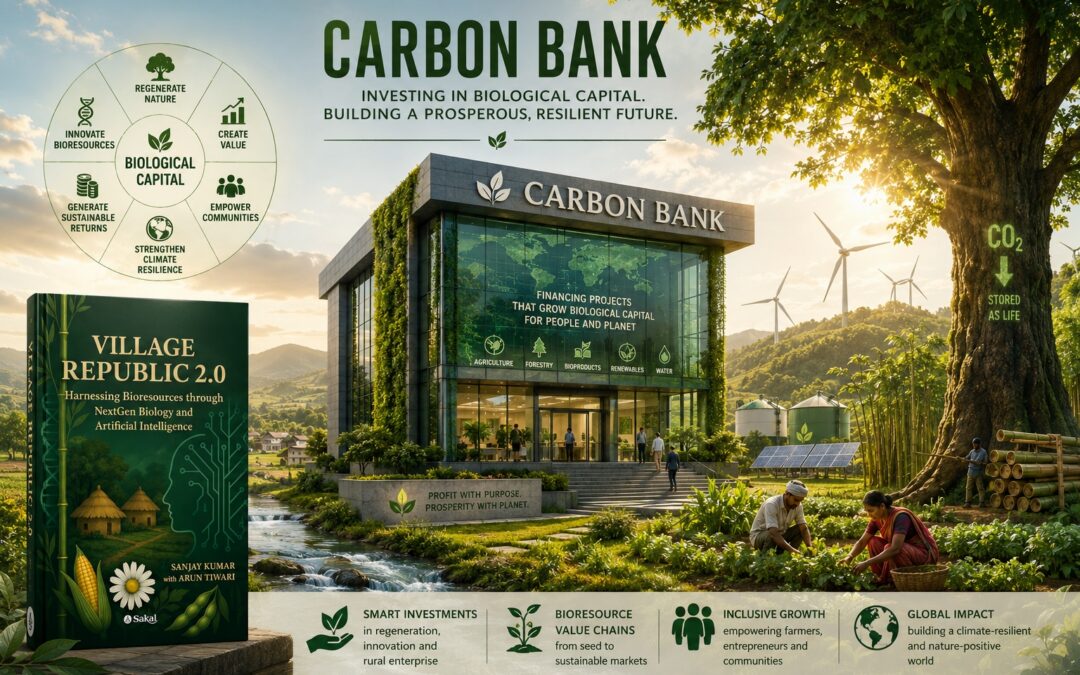
It is therefore time to imagine an institution designed not merely to finance projects but to build biological capital itself. That institution could simply be called the Carbon Bank.
Unlike existing carbon markets, which compensate for emissions already released, the Carbon Bank would invest proactively in expanding the world's stock of biological capital. Its initial capitalisation could be funded by a billion-dollar corpus contributed by governments, multilateral institutions, sovereign wealth funds, development banks, climate finance agencies, philanthropic foundations, and private investors. As successful enterprises mature, commercial returns would attract increasing private participation, allowing the Carbon Bank to evolve into a specialised investment institution for the global bioeconomy. Its mandate would be elegantly simple: identify, finance, create, and multiply biological capital.
Climate-resilient agriculture, regenerative farming, microbial technologies, precision irrigation, carbon-positive soils, medicinal and aromatic plant industries, bamboo enterprises, biodegradable plastics, biological fertilisers, AI-driven agriculture, genomics, rural biorefineries, post-harvest preservation, agricultural waste utilisation, digital extension systems, carbon monitoring technologies, and village-scale bio-manufacturing would all become investable assets. Instead of treating agriculture as a subsidy-dependent sector, the Carbon Bank would recognise it as the world's largest platform for creating long-term biological wealth.
Equally important, it would transform the philosophy of public investment. Rather than functioning as another grant-disbursing agency, it would operate according to the principles of investment banking. Its professionals would evaluate technological maturity, market opportunity, management capability, scalability, intellectual property, commercial viability, and long-term environmental returns. Their task would not be to eliminate every risk but to maximise the probability of extraordinary success.
Some investments would inevitably fail. That is not a defect of innovation. It is the cost of discovering the future. Every successful venture capital ecosystem demonstrates that a handful of exceptional enterprises more than compensate for numerous unsuccessful ones. Attempting to eliminate risk simply eliminates transformation.
The implications extend far beyond economics. Farmers would no longer be viewed merely as food producers. They would become custodians of biological capital. Every hectare restored would strengthen biodiversity. Every litre of water conserved would increase national resilience. Every tonne of biomass converted into high-value products would replace fossil-derived materials. Every successful rural enterprise would generate skilled employment where people live, rather than compelling migration to cities. Villages themselves would become centres of biological manufacturing, ecological restoration, and renewable prosperity.
Perhaps the greatest contribution of a Carbon Bank would be conceptual rather than financial. It would encourage governments, investors, and economists to redefine wealth itself. Gross Domestic Product measures economic activity. Financial capital measures accumulated wealth. Human capital measures knowledge and capability. The coming bioeconomy requires one additional measure—a nation's biological capital.
Countries that continually regenerate their soils, expand their forests, conserve water, improve biodiversity, strengthen microbial ecosystems, develop superior crop varieties, cultivate medicinal plants, commercialise bamboo, and convert agricultural biomass into advanced products are steadily increasing their biological capital. Such wealth is renewable, self-reinforcing, and resilient. It generates economic prosperity while simultaneously strengthening environmental security.
Business as usual rarely transforms civilisation. History changes when finance discovers entirely new forms of wealth. Two centuries ago it discovered industry. Half a century ago it discovered information. The twenty-first century must discover biology.
Carbon credits marked the beginning of that journey. The Carbon Bank represents its natural evolution—not merely as another financial institution, but as the world's first dedicated engine for creating biological capital. In the decades ahead, the wealthiest nations may no longer be those that possess the largest reserves of fossil fuels or the deepest financial markets. They will be those that understand, nurture, finance, and continuously expand the inexhaustible wealth embedded in living systems. Their greatest national asset will not be underground mines or oil wells, but the biological capital flourishing above the ground—in their farms, forests, rivers, wetlands, villages, and the extraordinary regenerative power of life itself.
— Dr Sanjay Kumar with Prof. Arun Tiwari
Should you be learning about the world of color analysis and wondering “what is my color palette,” there are wonderful options out there like gratis color analysis assessments and tools that enable you to determine your undertones and top season. deep summer If you tend towards a gentle winter, intense summer, or even bold winter color palette, exploring skin tone references and taking a skin color tone test can really help in picking colors that ideally work for you. For a more in-depth process, the 16 season color analysis system is very inclusive, and you can complete a 16 seasonal color analysis evaluation online for personalized results.
When you’ve been using Color Analysis Pro and decide to cancel your service, or just curious about how to maintain your subscription, there are basic steps to apply to cancel color analysis pro smoothly. Also, if you want to dive more deeply into subjects like light olive skin, red-toned skin, or subtle olive skin color tables, many resources give thorough info and samples. For further assistance with finding your color palette or grasping skin tone theory, you can read more .
If you’re currently examining your own color collection, tools like a coloring chart or a complexion analysis test camera can be truly effective in discovering whether you fall into a dark summer, light winter, or even a light olive skin tone. color analysis test free I’ve noticed that trying a zero-cost color analysis test or accessing an AI color analysis complimentary app can deliver fast results into what tones look perfect on a person and resolve questions like “what’s my color season” or “what tones match me.” For individuals interested in the extended season color analysis, tools and checks can narrow down your unique color scheme, whether it’s a rich summer palette or a light summer color palette, letting you uncover your color range with accuracy.
If you’re using subscription services like Color Analysis Pro but would like to know how to stop color analysis pro or the best way to leave the membership, there are clear steps and recommendations online to eliminate frustration. To get more details into these topics and learn more about deep winter color palette or muted winter palette choices, view this guide: . Whether you’re currently unsure about “which palette suits me” or are looking for advice on skin analysis, these options and discussions offer a solid jumping-off point!
If you are researching the world of color analysis and curious about “what is my color palette,” there are great instruments out there like no-cost color analysis evaluations and platforms that assist you identify your base tones and most flattering season. color analysis pro cancel subscription Whether you lean towards a gentle winter, rich summer, or even intense winter color palette, exploring skin tone diagrams and taking a skin complexion test can make a huge difference in finding colors that perfectly match you. For a more precise process, the 16 season color analysis framework is quite comprehensive, and you can complete a 16 seasonal color analysis evaluation online for tailored results.
When you’ve been using Color Analysis Pro and want to cancel your subscription, or only interested about how to handle your account, there are basic steps to complete to cancel color analysis pro quickly. Also, if you wish to dive further into elements like fair olive tone, red undertone skin, or subtle olive skin color tables, many platforms give comprehensive info and examples. For further help with determining your color palette or learning skin tone evaluation, you can learn more .
If you’re currently learning about your specific color palette, tools like a skin color chart or a skin undertone test camera can be really beneficial in figuring out whether you tend toward a vivid summer, delicate winter, or even a cool olive skin tone. 16 season color analysis test I learned that taking a zero-cost color analysis test or running an AI color analysis free app can generate immediate details into what hues look most suitable on you and resolve questions like “which season am I” or “what colors flatter me” For users looking into the sixteen season color analysis, tests and analyses can narrow down your unique color set, whether it’s a rich summer palette or a muted summer color palette, assisting you find your color range with assurance.
If you happen to be using online services like Color Analysis Pro but wish to know how to discontinue color analysis pro or the best way to leave the membership, there are straightforward steps and suggestions online to eliminate hassles. To dive deeper into these questions and find out more about rich winter color palette or light winter palette suggestions, visit this resource: . Whether you happen to be curious about “what’s my color palette” or require guidance on skin tone tests, these resources and forums give a valuable beginning!
Если собираетесь трип в австрийскую столицу, не забудьте заглянуть на зимние ярмарки в Вене-красавице в наступающем году — настроение там совершенно сказочная! Для тотального окунания в столицу важно увидеть его обзорные точки, например популярная обзорная площадка столицы, откуда разворачиваются великолепные виды. Настоятельно рекомендую предварительно просмотреть места столицы на схеме города, для того чтобы можно было составить практичный экскурсионный маршрут. Практичный руководство по столице Австрии можно найти здесь достопримечательности вены на карте .
Вдобавок, если требуется перемена обстановки, в столице присутствуют прекрасные пляжи и венский пляж — чудесные уголки для отдыха и развлечений. Для тех кто планирует увеличить программу поездки поездки, предлагаю вам посетить окрестные города. А тем, кто намерен открыть для себя балтийский город, предлагаю вам посетить на знаменитый блошиный рынок в Калининграде и выяснить, как удобнее добраться из этого города до местного аэропорта. За пять дней можно осмотреть немало и насладиться от экскурсии!
If you’ve been tinkering with Suno AI produced tracks, you certainly spotted those irritating flaws that can seriously hurt the sound clarity. suno artifact remover The good news is, there are some useful ways to get rid of Suno flaws using software like the Suno artifact remover or Suno audio purifier, which allow you to fix Suno AI issues and boost the total sound. These solutions are especially convenient if you plan to refine Suno AI tracks and make singing sound more natural.
For those finding it difficult to fix Suno music quality or upgrade Suno sound quality, web-based audio cleaners can be a huge help. You can find complimentary AI music enhancer options that assist in removing remove imperfections from Suno tracks and even streamline mastering your tracks digitally. If you’re interested, check out this tool that includes a fantastic interface to fix Suno voice output and upgrade your audio without any trouble.
Has anybody too faced challenges to eliminate certain Suno sound problems in their computer-generated content? suno ai artifact remover I detected that this AI glitches can significantly reduce the general sound output, primarily with vocal elements appearing robotic. To tackle this, I began employing a cleanup tool to process Suno AI tracks and consistently get rid of sound issues from the Suno recordings, which helps enhance both the sound clarity and precision.
For musicians wanting a quick means to fix those Suno audio problems challenges, there are various cost-free AI audio tools and audio artifact tools accessible online that can operate as a reliable audio cleaner or vocal cleaner. These utilities work as an powerful artifact remover and can work to cause your vocals sound human again. If you’re looking to check them out, listed here is a valuable option which offers an free online AI music cleaner and can assist with Suno mastering and elevating overall sound quality without stress.
If you have ever been tinkering with Suno AI made tracks, you most likely come across those troublesome distortions that can significantly affect the listening experience. suno mastering tool Happily, there are some proven ways to clean up Suno glitches using options like the Suno artifact eliminator or Suno audio enhancer, which assist you to fix Suno AI glitches and upgrade the full sound. These tools are highly handy if you want to improve Suno AI tracks and make sound appear more authentic.
For those trying to fix Suno music quality or boost Suno audio quality, online AI music cleaners can be a massive relief. You can explore zero-cost AI music optimizer options that allow you to remove glitches from Suno tracks and even streamline mastering your tracks digitally. If you’re curious, visit this resource that offers a wonderful system to fix Suno vocals and upgrade your audio without any trouble.
Did anybody among you had trouble to fix those Suno artifacts in their artificially created recordings? ai music cleaner online free I observed that the Suno AI flaws can really damage the complete sound clarity, mainly with vocal elements appearing less natural. To address this, I have been utilizing a dedicated tool to restore the AI tracks and easily strip out audio flaws from such Suno audio files, which helps boost both the overall sound and sharpness.
For users in need of a practical solution to correct any Suno sound issues problems, there are several cost-free audio cleaners and audio repair tools accessible online that can be used as a reliable audio cleaner or vocal enhancer. These tools act as an smart artifact remover and can enable you to turn these vocals sound more natural. Should you wish to explore them, here is a valuable guide that provides an complimentary AI music cleaner and can aid in sound mastering and refining track quality without stress.
Если собираетесь прогулочный маршрут по Калининграду на туристической карте, предлагаю побывать в микрорайон Амалиенау — весьма колоритное место с с великолепными улицами и захватывающими местами, включая дом с горгулей и исторический собор Калининград, где можно изучить много любопытных фактов. Не откажитесь от возможности также насладиться органное выступление в кафедральном соборе — говорят, что там смонтирован огромный орган в России, а дневной концерт органа Калининград подарит душевной атмосферой. Подробнее о пешеходных прогулках и примечательных местах города можно узнать тут форт 11 калининград как добраться .
Для тех кто любит природу и занятий на свежем воздухе предлагаю познакомиться с необустроенные пляжи Калининградской области, где можно ощутить отдыхом на природе вдали от других отдыхающих. Заранее разузнайте, когда лучше отправляться в Калининград и разрешено ли купаться в Балтийском море в Калининграде — купальный сезон в Калининграде определяется погодой, а температура воды на Куршской косе иногда позволяет насладиться купанием. Если вы хотите увидеть Форт 11 Калининград, как доехать на автобусе — это хороший вариант для знакомства с историей региона. Ещё обязательно стоит увидеть Правдинск и исторические места и Черняховск, чтобы разработать маршрут по Калининградской области на автомобиле еще содержательнее.
Если думаете о пешую прогулку по Калининграду на схеме, предлагаю посетить в зону Амалиенау — невероятно атмосферное уголок с потрясающими улицами и любопытными местами, включая знаменитый дом с горгульей и старинный собор Калининград, где можно изучить много увлекательных фактов. Не откажитесь от возможности также послушать концерт органной музыки в соборе — известно, что там стоит самый большой орган в России, а послеполуденный концерт Калининград принесёт душевной атмосферой. Всё о туристических маршрутах и красивых местах города можно изучить тут амалиенау самостоятельно .
Для ценителей природы и активного отдыха рекомендую посетить нетронутые пляжи Калининградской области, где можно насладиться нетронутой природой вдали от посетителей. Заблаговременно проверьте, когда предпочтительнее ехать в Калининград и безопасно ли купаться в Балтийском море в Калининграде — сезон купания в Калининграде диктуется климатом, а прогрев воды на Куршской косе временами позволяет принять морскую ванну. Если планируете изучить Форт 11 Калининград, как попасть на автобусе — это оптимальный способ для погружения в историю региона. Помимо этого рекомендую посетить Правдинск и исторические места и Черняховск, чтобы проложить маршрут по Калининградской области на собственной машине еще разнообразнее.