BioResource Economy: Where Ecology Meets Equity
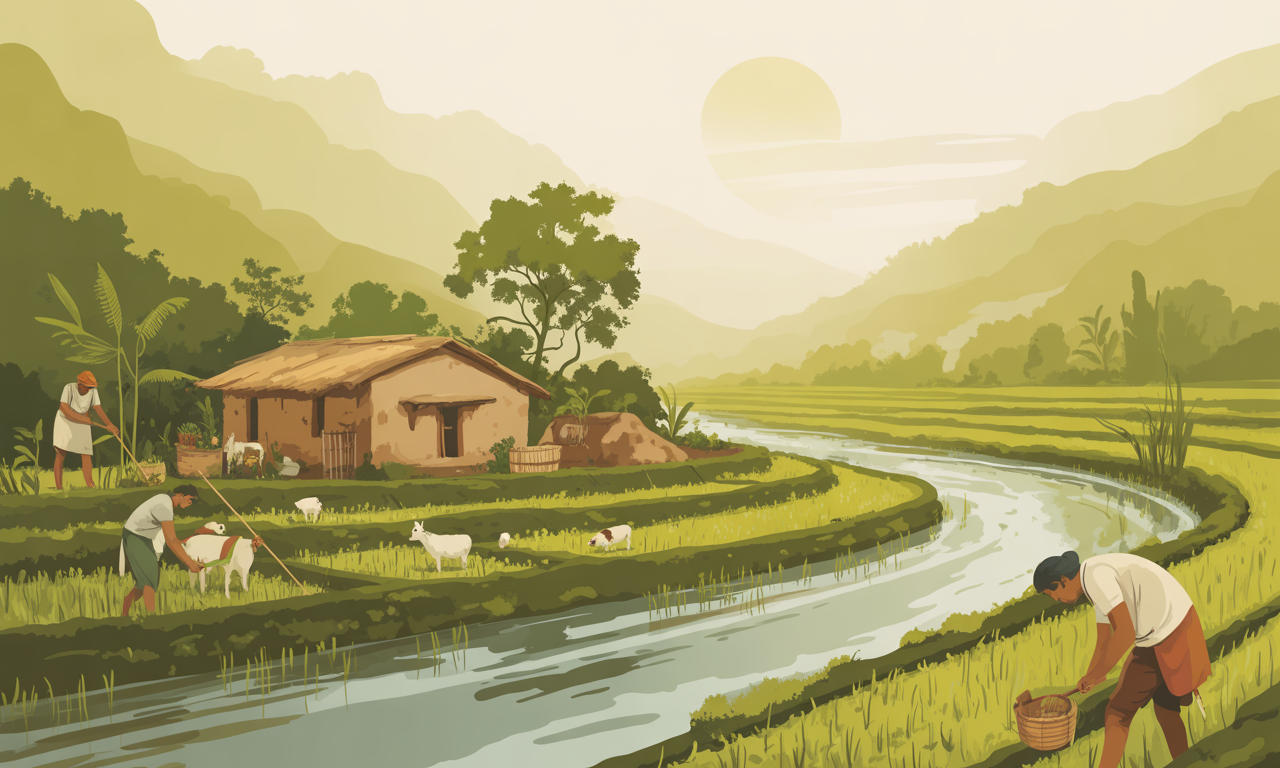
India's civilization has always drawn its strength from living resources. From the rice terraces of the east to the millet fields of the Deccan, from the sacred groves of the Western Ghats to the tank irrigation systems of Tamil Nadu, communities built prosperity on the careful use of soil, water, biodiversity, and sunlight. Today, as the nation faces the twin crises of ecological degradation and rural distress, it is time to recover this wisdom in a new form: the BioResource Economy.
Biology as Foundation
Prosperity guided by regeneration, not extraction
Science for People
Technology serving grassroots communities, not corporations
Ecology Meets Equity
Simple yet profound transformation principle
From Extraction to Regeneration
For decades, economic growth has been measured in terms of how much we can extract—minerals, oil, groundwater, even soil fertility. The result is declining farm productivity, polluted rivers, shrinking biodiversity, and vulnerable rural communities.
But India has an alternative. Our villages are surrounded by underutilised bio-resources—crop residues, agro-waste, weeds, livestock dung, biomass, microbes, and biodiversity hotspots. What is often treated as waste can, with the right science and enterprise, become wealth: bioenergy, biofertilizers, bio-based materials, nutraceuticals, and green chemicals.
As Dr. M.S. Swaminathan reminded us, the future of Indian agriculture lies in an evergreen revolution—productivity growth that enhances, rather than undermines, ecological foundations.

The BioResource Economy builds directly on this ethic of regenerative growth.
Equity at the Core
A true bioresource revolution cannot mirror the mistakes of industrial agriculture, where profits accumulate in boardrooms while risks remain with farmers. The mission must ensure that wealth circulates within villages, not drain out of them.
Women Farmers
Managing seed banks and sharing in prosperity they generate
Tribal Communities
Protecting forests whilst benefiting from conservation efforts
Rural Youth
Running village-level processing units and innovation centres
Smallholders
Owning technologies and markets, not depending on corporations
Mahatma Gandhi's talisman—"Recall the face of the poorest and ask if your step will restore her dignity"—is the moral compass here. The BioResource Economy must be judged not by GDP figures, but by whether it lifts the weakest, regenerates the land, and keeps communities resilient.
The Science of a BioResource Future
India is well-placed to lead this transition. Our scientific institutions already generate knowledge that can transform rural livelihoods if it is democratised:
Biotechnology for Regeneration
Microbial consortia and biofertilizers reduce chemical dependence and restore soil life. Marker-assisted breeding improves millets, pulses, and oilseeds for resilience whilst safeguarding biodiversity.
AI and Digital Tools for Empowerment
Satellite data and AI can map soil carbon, water stress, or pest outbreaks, giving farmers timely, actionable insights. When translated into local languages and delivered via mobile phones, these tools become grassroots assets rather than corporate monopolies.
Circular Bio-economies
Residues from sugarcane can be converted into bio-ethanol; rice straw can be transformed into packaging material; and cow dung can power biogas plants. When villages own and operate these value chains, income multiplies whilst emissions shrink.
This is science in service of society—a Gandhian model of "affordable excellence" articulated by R.A. Mashelkar.
Building Local Value Chains
For a BioResource Economy to flourish, local processing and value addition are key. Too often, raw materials leave villages cheaply whilst finished products return at high prices. This cycle must be reversed.
Millet Growing Cluster
Farmers in Telangana establish cooperative mill instead of selling raw grain
Value Addition
Producing flour and ready-to-eat mixes, with by-products feeding cattle
Circular Processing
Cow dung powers biogas unit, residues become organic manure
Community Ownership
Women's self-help groups run packaging, youth manage AI-enabled supply chains
Wealth Retention
Income generated at every step stays within the community
This is not theory—it is already happening in parts of Kerala's Kudumbashree movement and in farmer producer organisations across Madhya Pradesh and Rajasthan. Scaling these successes is the real challenge.
Policy Pathways
Procurement Reforms
Public distribution and midday meal schemes can prioritize bioresource-based crops like millets, pulses, and oilseeds.
Incentives for Ecosystem Services
Farmers who increase soil carbon or conserve biodiversity should be rewarded through carbon credits and payments for ecosystem services.
Decentralised Energy Grids
Biomass and biogas-based systems can power villages whilst reducing fossil fuel dependence.
Education and Training
A "Green Leadership Corps" of rural youth trained in soil stewardship, bio-entrepreneurship, and AI-enabled advisories can become the torchbearers of change.
Policy must recognise that the BioResource Economy is not a subsidy-driven scheme but an investment in resilience and dignity.
Culture and Community

Rabindranath Tagore once wrote that India's future rests in the harmony between man and nature, between tradition and modernity. The BioResource Economy embodies this spirit.
It values community seed banks as much as genome editing, panchayat-led composting as much as AI-based forecasting. Above all, it is a cultural renewal. It restores pride in farming as a knowledge-driven profession, not a survival occupation. It honours women as custodians of biodiversity, youth as innovators, and farmers as stewards of the earth.
Toward a Just Prosperity
The BioResource Economy is not only about green growth; it is about just growth. It is about creating prosperity without displacing people, regenerating soils without poisoning rivers, and building markets without marginalising the smallest producer.
In this economy, ecology and equity are not competing goals; they are twin pillars of the same structure. As we move toward India@100, we have the chance to show the world that a billion people can prosper by nurturing life, not by exhausting it.
Conclusion: India's Covenant
"Where Ecology Meets Equity" is more than a theme line. It is a mission for India's future. By placing biology at the heart of our economy and ensuring that benefits reach the last mile, we can create a nation where science serves people, where wealth is regenerative, and where dignity is rooted in the soil itself.
The BioResource Economy is India's covenant with her land and her people: to harness nature's abundance, empower communities, and align prosperity with the planet's well-being.