Genomics tells us what genes are present and how they vary. Physiology tells us how plants actually behave—how they breathe, drink, photosynthesize, endure heat, or set seed under stress. Translational research is the bridge between the two: it moves discoveries from the lab bench to the seed bag in a farmer’s hand.
Over the last decade, genomics has shifted from sequencing a few model plants to genomics-assisted breeding (GAB) and genomic selection (GS) for major crops. Instead of waiting multiple seasons to see whether a plant is drought-tolerant or disease-resistant, breeders can now scan its DNA for marker combinations linked to target traits.
But genes don’t act in a vacuum. They express under specific soil, climate, and management conditions. That is where crop physiology and high-throughput phenotyping come in—capturing detailed traits such as root depth, leaf temperature, transpiration efficiency, or “stay-green” under drought and heat.
India has invested steadily in genomic infrastructure and networks. The ICAR Consortium Research Platform (CRP) on Genomics, launched in 2015 and reviewed again in 2025, is a flagship example. It connects multiple ICAR institutes to work on structural and functional genomics of crops, livestock, and fisheries, explicitly aiming to deliver breeder-ready tools and resilient germplasm.
On the breeding side, India has already delivered cited success stories globally: chickpea, pigeonpea, and groundnut. Genomics-assisted breeding has led to new lines with improved drought tolerance, disease resistance, and productivity, moving “from genomes to fields and markets” within a decade. Draft genomes of key legumes, such as pigeonpea, have expanded the genetic resources available to resource-poor farmers.
Marker-assisted selection (MAS) is now routinely used in public breeding programmes to pyramid genes for resistance and quality traits across cereals, pulses and oilseeds. At the same time, initiatives like National Innovations in Climate Resilient Agriculture (NICRA) link these breeding efforts to climate-smart agronomy—water harvesting, contingency cropping, and carbon-smart soil management – in hundreds of climatically vulnerable villages.
Taken together, India has already built the scaffolding of a translational genomics ecosystem: genome platforms, breeder networks, climate-smart field labs, and an enormous diversity of farmer environments.
Many countries do genomics. Fewer systematically integrate crop physiology into breeding and policy. Here, India has a unique opportunity. Recent work on drought and heat tolerance in crops such as rice, wheat, sorghum, and legumes shows that traits such as root architecture, canopy temperature, transpiration efficiency, and stay-green behaviour are central to developing climate-ready varieties.
If India deliberately positions physiology as the “translator” between genes and fields, it can prioritize traits that matter for smallholders—e.g., terminal heat tolerance in wheat, post-flowering drought tolerance in sorghum, and water-use efficiency in pulses; Optimize the management of new varieties, ensuring fertilizer, water, and planting windows align with their physiological strengths.
High-throughput phenotyping using drones, imaging, and sensor-based platforms is allowing breeders to capture complex physiological traits at scale and feed that information back into genomic selection pipelines. AI-enabled agri-platforms developed in India are already integrating satellite, sensor, and management data to support phenotyping, yield prediction, and climate-risk advisories. All of this creates the ingredients for data-rich, farmer-centric translational research—where varietal design, physiological insight and digital decision-support co-evolve.
The next step is a clear “Genome-to-Village” mission that: Sets time-bound targets for releasing climate-smart, genomics-assisted varieties in every major agro-climatic zone; Funds last-mile seed systems and participatory varietal selection so that farmers’ feedback loops into breeding cycles; Embeds physiological trait evaluation (e.g., water-use efficiency, root traits) as a standard in national trials, not a niche research activity.
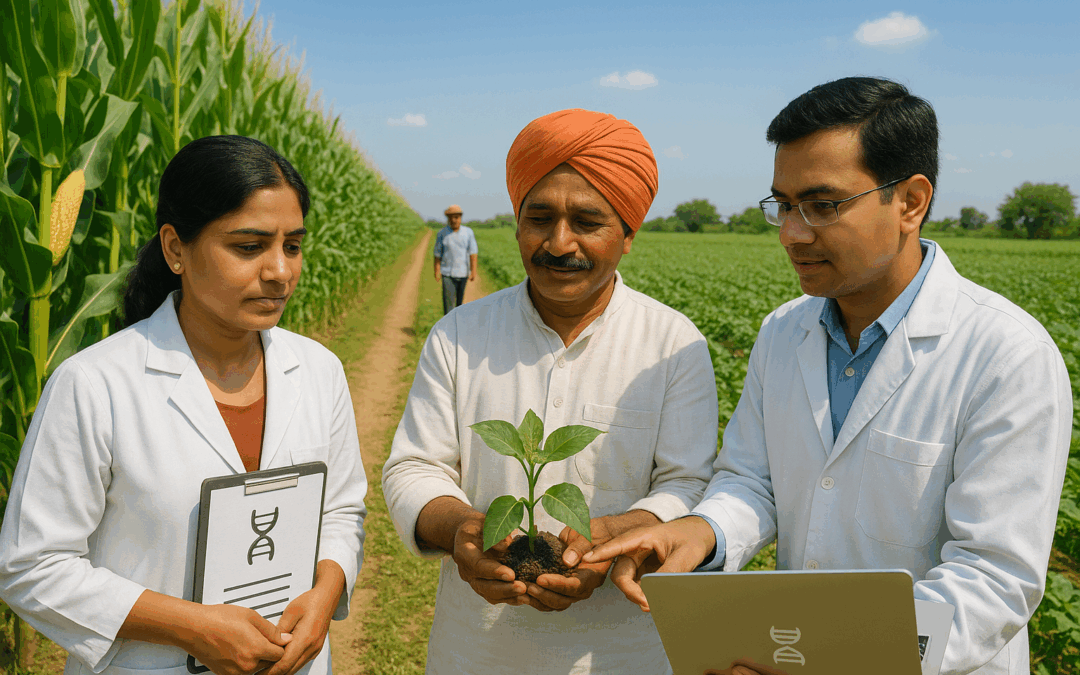
The KVKs already demonstrate technologies on farmers’ fields. They can be upgraded into Translational Genomics & Physiology Hubs where: new genomic lines are co-tested with farmers under realistic constraints; tools such as handheld sensors, canopy temperature cameras, and simple phenotyping protocols are used locally; and advisory packages combine seed, soil, water, and climate information into one integrated recommendation. This would turn KVKs into living classrooms where farmers, scientists and startups co-create solutions.
India’s young scientists are adept at bioinformatics, machine learning and statistics. The challenge is to develop a group of translational breeders and physiologists who are equally proficient in: Genomic tools (QTL mapping, GWAS, GS, genome editing); Field physiology and modelling; Social science and gender-sensitive, farmer-involved methods. Such professionals can serve as links between the genome laboratory, the field experiments, and the community, ensuring that the traits we pursue genuinely reflect farmers' real lives.
It is high time to put sustainability metrics at the center. Translational genomics for sustainable agriculture must be measured not just by yield, but by: water saved per kilogram of grain or biomass; nitrogen-use efficiency and reduced fertiliser dependence; soil carbon gains and biodiversity support; and above all, farmer income stability under climate shocks India’s climate-resilient pilots and national databases (on soils, crops, weather) make it possible to design sustainability dashboards that track the real impact of new varieties and practices over time.
If India can show that a small, affordable seed—developed through genomics, validated through physiology, and improved by climate-smart practices and digital tools—can produce higher yields with less water, fewer inputs, and lower risk for smallholder farmers, it will secure the country’s future in food and nutrition while providing a scalable model for Asia, Africa, and the Global South.
Translational genomics and physiology are not merely about improving crops—they are about reimagining agriculture as a knowledge-powered, low-carbon, farmer-first system. If India proves this at scale, it will not just feed itself; it will lead the world toward a truly sustainable agricultural future.