India is a land of abundant sunshine, yet it quietly endures a public-health paradox: widespread vitamin D deficiency. What was once seen as a niche biochemical concern has now become a population-wide alarm, crossing age groups, regions, income levels, and dietary habits. Numerous Indian studies over the past two decades consistently show that most Indians—often well over half, and in some cases nearly nine out of ten—have inadequate vitamin D levels. This contradiction between plentiful sunlight and biological deficiency reveals a deeper truth about modern life: the conditions for health no longer develop automatically from geography; they must be intentionally fostered through food systems, lifestyles, and policy.
Vitamin D is often described narrowly as a “bone vitamin,” but this understates its biological reach. It functions more like a hormone than a conventional nutrient, influencing calcium absorption, skeletal mineralization, muscle strength, immune regulation, and inflammatory balance. Chronic deficiency manifests visibly as rickets in children and as osteomalacia and osteoporosis in adults, but the earlier and subtler signs often go unnoticed. Low bone density can begin decades silently before fractures appear, particularly in young adults who assume bone loss is an “old-age problem.”
Increasingly, clinicians are also observing associations between vitamin D deficiency and early hair thinning or hair loss, especially when deficiency coexists with calcium imbalance, poor protein intake, or chronic inflammation. These signs—bone demineralization and premature hair loss—are not cosmetic inconveniences; they are biological warning lights.
The cumulative burden is considerable. Reduced bone density raises lifetime fracture risk, impairs mobility, and hastens frailty in later years. Muscle weakness and tiredness reduce physical activity, creating a vicious cycle that further weakens bones. Hair follicles, among the body’s fastest dividing tissues, are vulnerable to micronutrient and hormonal disturbances. When vitamin D stays chronically low, hair growth cycles shorten, shedding increases, and recovery slows down. In a society already facing sedentary lifestyles, metabolic disease, and aging populations, these outcomes quietly diminish productivity, confidence, and long-term health.
The roots of India’s vitamin D problem lie not in biology but in lifestyle transitions. Vitamin D synthesis begins in the skin when ultraviolet-B (UVB) rays convert a cholesterol-derived compound into vitamin D3, later activated in the liver and kidneys. Historically, this process was supported by outdoor work, open housing, and routine sun exposure. Today, long indoor hours, dense urban housing, air pollution that filters UVB radiation, heat avoidance, sunscreen use, and cultural clothing practices interrupt this natural pathway. Darker skin pigmentation, while protective against ultraviolet damage, further reduces synthesis efficiency, requiring longer exposure for the same vitamin D production. The result is a population biologically adapted to sunlight but behaviorally insulated from it.
Diet provides little compensation. Very few foods naturally contain vitamin D, and many—fatty fish, liver, egg yolk—are either costly or excluded from vegetarian diets common in India. Calcium-rich foods may be present, but without adequate vitamin D, calcium absorption remains inefficient, directly contributing to low bone density even in those who believe their diet is “adequate.” Supplementation and fortification help, but they face challenges in terms of access, compliance, misinformation, and quality control. Reports of excessive or adulterated vitamin D products have eroded public trust, underscoring the risks of relying solely on pill-based solutions.
This is where mushrooms enter the story—not as a novelty, but as a biologically elegant solution. Mushrooms naturally contain ergosterol, a compound structurally similar to cholesterol. When exposed to ultraviolet light, ergosterol converts into vitamin D2, a form absorbable and usable by humans. This transformation mirrors human skin’s vitamin D synthesis, involving no genetic modification or chemical fortification, but a simple photochemical reaction grounded in natural physiology and food science.
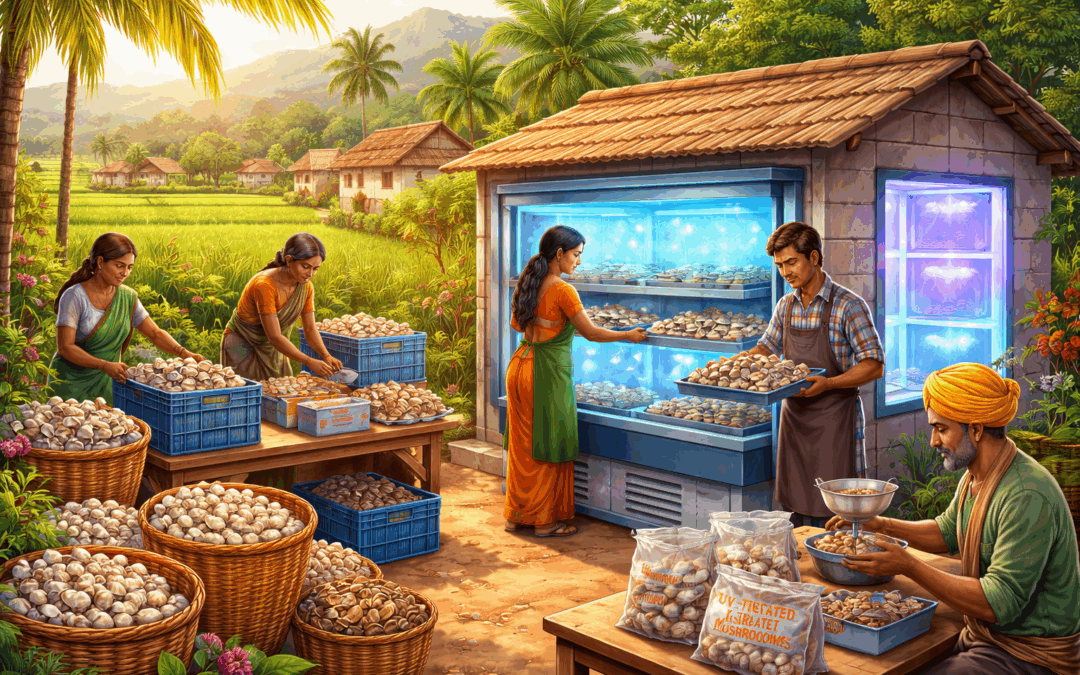
The implications for India are substantial. UV-treated mushrooms offer one of the rare vegetarian-friendly dietary sources of vitamin D. They can be enriched after harvest, without new crop varieties or complex biotechnology. Mushrooms can be exposed to UV light at farms, collection centers, or packing units and distributed through existing vegetable markets. Research shows that consuming UV-exposed mushrooms improves vitamin D status, particularly in those already deficient—precisely the population experiencing early bone loss, muscle weakness, or unexplained hair thinning.
In practical terms, UV treatment is straightforward. Harvested mushrooms are exposed to UVB light for a controlled duration, converting ergosterol into vitamin D2. The final content depends on species, surface area, moisture, UV dose, and storage, making standardization and labeling essential. When protocols are followed, producers can deliver consistent vitamin D levels per serving, transforming an everyday vegetable into a functional food with measurable public health impact.
At the household level, adoption is seamless. UV-treated mushrooms integrate easily into Indian cooking—sabzis, curries, pulao, soups, noodles, and stir-fries. Because vitamin D is fat-soluble, cooking with a small amount of oil enhances absorption. Regular consumption, even a few times a week, combined with calcium-rich foods such as milk, curd, ragi, sesame, and leafy greens, supports bone mineralization and may help stabilize hair growth cycles over time. This approach complements sunlight rather than replacing it, recognizing the realities of indoor lifestyles.
Safety is a key strength of this food-based strategy. Unlike high-dose supplements, UV-treated mushrooms provide nutritionally appropriate, physiologically relevant amounts of vitamin D. When produced under food safety standards and clearly labelled, they reduce the risk of excess while steadily correcting deficiency. Clinical supervision remains essential for high-risk groups, but for the general population, food-based delivery is safer and more sustainable.
From a public health perspective, UV-treated mushrooms represent a system-level opportunity. India already has mushroom cultivation clusters, farmer-producer organizations, and rural entrepreneurs. Adding small-scale UV treatment units enables local value addition, rural employment, and nutritional resilience. Institutions—hostels, canteens, community kitchens, and elderly nutrition programs—can incorporate these mushrooms alongside calcium and protein interventions, addressing low bone density early, long before fractures emerge.
Vitamin D deficiency is ultimately a symptom of a disconnect between human biology and modern living. Its early signals—bone thinning, muscle weakness, fatigue, and premature hair loss—are warnings that precede irreversible damage. Turning humble mushrooms into a vitamin D vehicle exemplifies a quiet yet powerful correction: it leverages nature’s chemistry, respects dietary diversity, integrates into existing food systems, and addresses deficiency safely and at scale. In doing so, it offers India a practical path to restoring skeletal strength, biological resilience, and everyday vitality—even in a sun-drenched nation that has learned to live indoors.
— Dr Sanjay Kumar, Prof. Arun Tiwari