
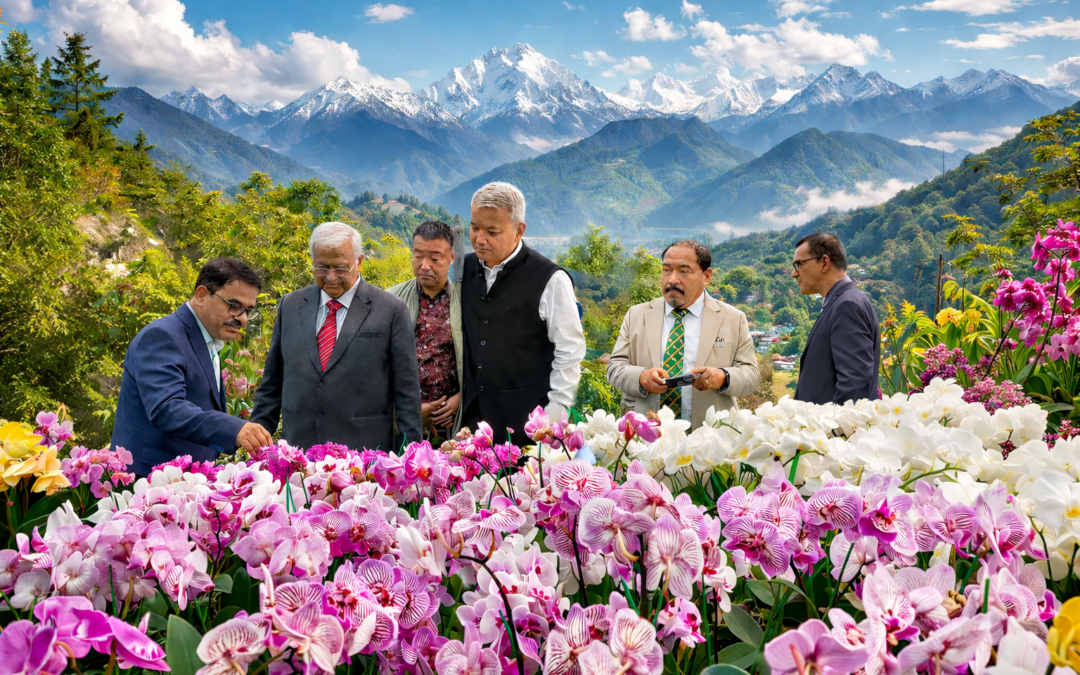
I recently visited the ICAR–National Research Centre for Orchids in Pakyong, Sikkim, established in 1996 by the Indian Council of Agricultural Research (ICAR), New Delhi. Hosted by its Director, Dr Sankar Prasad Das, the visit proved far more than a botanical tour. It was an encounter with one of nature’s most remarkable bioresources. Orchids, belonging to the family Orchidaceae, represent one of the largest and most evolutionarily sophisticated groups of flowering plants on Earth. More than 28,000 species are known globally, along with over 100,000 horticultural hybrids developed by breeders.
Their diversity is especially remarkable in the Himalayan and northeastern regions of India. The gradients of altitude, humidity, and forest ecology create perfect habitats for epiphytic orchids—plants that grow on tree trunks and branches rather than in soil. India itself is home to nearly 1,300 orchid species, many of which are endemic and ecologically specialised. The Pakyong research centre is strategically situated within this biodiversity-rich landscape and functions as a national hub for orchid germplasm conservation, taxonomy, breeding, biotechnology, and sustainable floriculture development.
Orchids are biological masterpieces shaped by millions of years of evolutionary experimentation. Their flowers exhibit extraordinary adaptations designed to attract highly specific pollinators—bees, moths, birds, and flies. Some orchids mimic insects in colour and shape, while others release fragrances that chemically resemble insect pheromones. These intricate interactions represent some of the most sophisticated examples of co-evolution in the plant kingdom. For scientists, orchids provide powerful model systems for studying evolutionary genetics, plant signalling, and chemical ecology.
Their reproductive biology adds another layer of complexity. Orchid seeds are microscopic—almost dust-like—and typically cannot germinate without symbiotic fungi that provide essential nutrients during early growth. This delicate ecological partnership between orchid seeds and mycorrhizal fungi fascinated botanists for decades until modern biotechnology transformed orchid propagation.
The revolution came with plant tissue culture and micropropagation. Through these techniques, scientists can generate thousands of genetically identical orchid plantlets from tiny pieces of plant tissue under sterile laboratory conditions. These plantlets are nurtured in controlled growth media before being transferred to greenhouses for acclimatisation and commercial cultivation. Laboratories across India, including those associated with the ICAR centre in Pakyong, have developed advanced protocols for in-vitro seed germination, somatic embryogenesis, virus-free plant production, and rapid multiplication of elite hybrids. These technologies simultaneously conserve rare species and enable large-scale floriculture production.
The economic potential of orchids is equally striking. Worldwide, orchids represent one of the most valuable segments of the ornamental plant industry. Countries such as Thailand, Taiwan, Singapore, and the Netherlands have built thriving export economies around orchid cultivation. The global orchid trade, driven by demand for cut flowers, potted plants, and landscaping varieties, is estimated to be worth several billion dollars annually.
India, despite its extraordinary orchid biodiversity, has only begun to explore this opportunity. For hill states such as Sikkim, Arunachal Pradesh, Meghalaya, and parts of the Western Ghats, orchids offer a high-value crop requiring relatively little land. Many species grow naturally as epiphytes, deriving nutrients from moisture and organic debris in the air rather than from soil. This ecological trait makes orchids ideal candidates for sustainable horticulture in mountainous ecosystems where land resources are limited.
The future of orchids will extend beyond floriculture into the rapidly advancing domain of Next-Generation Biology. Modern genomics now allows scientists to sequence orchid genomes, revealing the genetic basis of flower colour, fragrance pathways, disease resistance, and environmental adaptation. Gene-editing technologies such as CRISPR may eventually enable the development of entirely new orchid varieties with novel colours, enhanced fragrances, and improved resilience to climate stress.
Meanwhile, metabolomics and biochemical profiling are opening another frontier. Certain orchid genera, such as Dendrobium, have long been used in traditional Asian medicine for their antioxidant and therapeutic properties. Modern analytical tools can identify these compounds and explore their biomedical applications, potentially leading to orchid-based natural product industries that combine biodiversity conservation with biotechnology entrepreneurship.
Artificial intelligence and digital greenhouse systems will further reshape orchid cultivation. Sensor networks can monitor humidity, temperature, and nutrient levels in real time, while predictive algorithms can optimise flowering cycles and disease management. Digital platforms may soon support national orchid atlases, genomic databases, and transparent supply chains connecting growers directly to global markets.
An intriguing scientific possibility also lies in the relationship between orchids and pollinators. Most orchids are not natural attractants for honey bees and therefore do not ordinarily contribute to honey production. However, selective breeding to modify floral traits could potentially produce orchid varieties more attractive to honey bees, opening the possibility of orchid-derived honey. Although still speculative, this idea illustrates how plant breeding and ecological design may create entirely new agricultural niches.
Beyond science and commerce lies an equally important human dimension. Orchid cultivation can generate rural entrepreneurship and livelihoods. Cluster-based orchid farming, supported by farmer-producer organisations and training programmes, can empower women and youth in mountainous regions. Such initiatives can transform orchids into engines of sustainable local economies.
Orchids also possess immense potential for tourism and cultural engagement. Botanical gardens, orchid festivals, and eco-tourism circuits can attract visitors from across the world while promoting biodiversity awareness. Regions rich in orchid diversity—particularly the Eastern Himalaya—could become global centres of botanical tourism.
Yet the extraordinary beauty of orchids also masks their vulnerability. Many species face serious threats in the wild due to habitat destruction, climate change, and illegal collection. Conservation therefore remains central to orchid science. Institutions such as the ICAR research centre at Pakyong maintain living collections, seed banks, and tissue-culture repositories to safeguard genetic diversity. Modern technologies further strengthen these efforts through DNA barcoding for species identification, genomic mapping for conservation planning, and cryopreservation for long-term preservation.
Walking through the greenhouses and experimental plots at Pakyong, one begins to appreciate orchids as more than ornamental plants. They are living embodiments of evolutionary intelligence—organisms that mastered aerial existence, intricate pollination strategies, and symbiotic ecological partnerships. Their delicate flowers represent deep biological engineering refined over millions of years.
As I returned to Delhi after my visit, a thought occurred to me during a conversation with Dr Sankar Prasad Das. The word “orchid”, though widely used, originates from ancient Greek botanical terminology and carries an antiquated echo. Why not imagine a new identity for these extraordinary plants—one that reflects both their ecological ingenuity and future scientific relevance?
I suggested the name AeroTerraFlora.
The name captures the ecological duality of orchids. Many species live suspended in the air on tree branches as epiphytes, while others grow in soil or cling to rocks. Few plant families display such ecological versatility. The term AeroTerraFlora symbolises this remarkable ability to thrive both in the air and on the ground.
More importantly, the name reflects the emerging future of orchid science. Orchids are no longer merely decorative flowers; they are platforms for biodiversity conservation, biotechnology innovation, sustainable agriculture, and bioeconomic development. They represent a fusion of natural evolution and human ingenuity.
In that sense, AeroTerraFlora is not merely a new name—it is a vision. An identity that recognises orchids as icons of a future where biodiversity, biotechnology, and ecological stewardship converge to shape the future of life on Earth.
— Dr Sanjay Kumar, Prof. Arun Tiwari
Respected sir
Thank you very much sharing this wonderful information. Orchids are very beautiful flowers. NRC Orchid, Pakyong working nicely in this sector r also having one Regional Station in Darjeeling. I too visited NRCO twice. Visit of Dr Sanjay Kumar sir will again boos the energy of the scientists of the Institute to do further endeavours in the sector. He is an encyclopaedia of Himalayan flora including Orchids. He did pioneer work in RnD of Himalayan Biodiversity. Thank you very much for designing this article in such a nice form, which is very much informative. With regards.