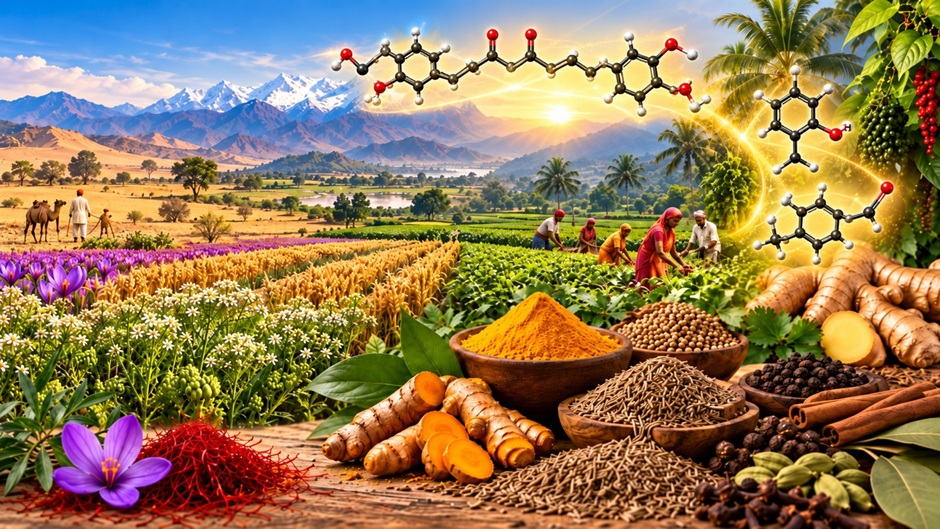
Something remarkable about the Indian kitchen is the spice box. It holds almost a dozen smaller compartments: yellow Haldi (turmeric), red mirch (chilli), dhaniya (coriander) powder, and many seeds: jeera (cumin), methi (fenugreek), ajwain (carom seeds), and, of course, heeng (asafoetida) in a separate airtight bottle. Elaichi (cardamom), laung (cloves) and kali mirch (black pepper) also sit in different bottles. Tejpat (Indian bay leaf) and dalchini (cinnamon) are normally kept in a jar. The house knows the cooking is underway by the crackle of some of these seeds in hot oil, a few curry leaves, or a pinch of asafoetida. Within seconds, the food's character changes.
What seems like a simple culinary tradition is actually an elegant exercise in plant biochemistry, solvent extraction, thermal chemistry, and sensory neuroscience. The interesting fact is that spices are not primarily nutrients. But they are integral to Indian food, repositories of biologically active molecules that plants evolved for survival. Our ancestors discovered that these molecules could transform food's flavour, aroma, and sometimes its keeping quality, and Indian cooking developed sophisticated techniques to extract and combine them.
A cumin plant does not produce its characteristic fragrance for a cook's benefit. A chilli does not contain capsaicin to make a curry exciting. Plants cannot run away from insects, fungi, herbivores, or microbial infection. They have therefore evolved elaborate chemical defence systems to repel insects, suppress microbial growth, discourage feeding, attract pollinators, or help plants respond to environmental stress. Humans used these compounds in cooking long before identifying their molecular structures.
The most fascinating part of the chemistry is why spices crack in hot oil. A spice seed is a miniature biological container. Its aromatic molecules may be stored in oil glands, specialised cells, or seed-coat-protected tissues. Putting a whole seed into boiling water does not necessarily release all these substances efficiently. Hot oil tempering, called tadka or chhonk, solves this problem through several mechanisms. At the molecular level, nothing mystical is happening: substances that were previously trapped become more accessible.
Mustard seeds reveal an even more interesting enzyme system. Many mustard seeds contain glucosinolates and myrosinase enzyme, but they are stored separately. When the seed is crushed and moisture becomes available, myrosinase converts glucosinolates into products, including pungent isothiocyanates. The process changes when whole mustard seeds are dropped directly into very hot oil; myrosinase can be rapidly inactivated by heat. The resulting flavour is therefore not identical to that of freshly crushed mustard mixed with water. This is why mustard paste, mustard sauce, and mustard seeds fried in tadka have distinctly different flavour profiles. Indian cuisine uses both techniques intelligently.
India possesses remarkable botanical diversity. Black pepper and small cardamom are associated with the Western Ghats. Turmeric and ginger grow across several regions in India. Cumin is one of the most important spices crops, which is predominantly grown in Western India, particularly Rajasthan and Gujarat. Mustard, fenugreek, coriander, and fennel are all major North and West Indian crops. However, chilli peppers originated in the Americas and spread widely after Columbus went there; they became integral to Indian cooking only in the last several centuries.
The science of spices reveals something beautiful about the relationship between plants and human civilisation. A plant manufactures an aromatic compound for its own biological reasons. That compound may repel an insect, interfere with a microorganism, or communicate with another organism. Humans encounter the compound through their senses. An otherwise defensive substance becomes a source of pleasure. Over generations, cooks discover that crushing releases one sensation, heating another, and dissolving in fat a third. These observations are preserved in recipes, passed between families, and gradually become cuisine.
The Indian tadka is an elegant example of empirical science embedded in tradition. The familiar instruction to heat cumin until fragrant or mustard seeds until they pop is a practical sensory endpoint. It tells the cook when the extraction has progressed far enough, without a thermometer or laboratory. And perhaps this is the most interesting lesson: Cooking with spices is not merely adding flavour to food. It is the controlled release, transformation, and delivery of molecules that evolved in plants long before human beings learned to cook.
Modern India is witnessing a significant transformation in its spice culture. For generations, households purchased whole spices, roasted or ground them, and prepared mixtures according to family preferences. Then packaged spice powders started coming. Today, companies increasingly sell not merely spices, but ready-made flavour combinations for particular dishes and occasions.
Two related trends are driving this shift: the growth of packaged, branded masalas used during cooking, and the growing popularity of sprinkle-on seasonings applied to prepared food. The movement is from spices as ingredients to spices as convenient, standardised flavour solutions.
We see an intriguing cultural and biochemical paradox here.
Traditional Indian cooking separates spice addition into stages: tempering whole seeds, frying ground masalas, and simmering and finishing with aromatics. Each stage serves a different chemical purpose. Ready-made mixtures save time and deliver consistency, but they can also encourage the cook to treat flavour as something added from a packet rather than developed through controlled heating and interaction with the food.
Yet this is not necessarily culinary decline. A carefully designed commercial masala can contain high-quality ingredients, be hygienically processed and reproduce a complex regional flavour remarkably well. The real issue is whether consumers understand what is inside the packet.
For everyday use, we would distinguish pure spice blends from seasoning products that contain substantial salt or sugar. Reading the ingredient list and sodium content is more meaningful than relying on claims such as natural, authentic, or traditional. Branded products should also be judged on quality testing and regulatory compliance, not brand reputation alone.
The traditional Indian masala box represented a collection of ingredients and the cook's knowledge of how to use them. The modern branded spice mixture packages some of that knowledge into a convenient product. The future need not be a choice between the two. The best kitchen can use quality commercial blends for convenience while retaining the essential understanding of how heat, oil, moisture, and timing release flavour.
The growing dependence on online food delivery and ready-made masala blends, even in kitchens where meals are still prepared at home, presents a double threat to traditional culinary knowledge. When food arrives fully prepared, we lose sight of its ingredients and how it's made. When flavour comes from a branded packet, we gradually forget why particular spices are combined, when to add them, and how heat, oil, and moisture transform their chemistry.
The greater loss is not of recipes but of understanding. Traditional cooking represents generations of accumulated observations about plants, food preservation, digestion, nourishment, and the human body. Not every inherited practice is scientifically valid, but much of this knowledge deserves examination, understanding, and preservation rather than silent abandonment.
If younger generations aren't taught what they eat, how food is prepared, and how its constituents interact biochemically with their bodies, convenience may come at an unforeseen price. We risk losing a body of practical survival knowledge, patiently curated over centuries, without even recognising what has disappeared.
A civilisation loses its food wisdom not merely when it stops cooking. It begins to lose it when people no longer understand what they cook—or what they eat.
— Dr Sanjay Kumar with Prof Arun Tiwari
A rehearsal playback check has raised a question about a generated track. A few passages become harsh in the room, while headphones make the problem harder to identify. My first priority is to understand whether the room is exaggerating the sound. I can compare another speaker, lower the level, and listen from several positions. Which comparison would you make first in this situation? One topic I am reading about is suno fix in this context. That gives me a starting point for questions, but it cannot diagnose our room. If the roughness follows the file, I would keep the original and test only a short copy. I will use the same excerpt for every comparison, write down the playback level, and ask another person to listen before we make any decision about changing the source recording. The useful result would be reliable playback that preserves the timing cues for everyone.
One sustained note in our current song sketch has a scratchy edge. The rest of the phrase works for the melody, and my writing partner wants to keep its timing. Starting the section again could disturb the phrasing. We can try another generation of the same musical passage, but that might also replace the little pause that makes the line convincing. I started looking into ai music artifact removal as one possible route, without assuming it can rescue this particular note. For now we only need a useful songwriting sketch. We are not facing a delivery deadline. Would you first shorten the note, replace that phrase, or test a conservative cleanup on a copy? Keeping the character of the vocal matters most. An imperfect note could still serve the sketch. What would make you abandon repair and regenerate?
Unos amigos y yo buscamos una visita a una bodega mallorquina que permita entender el trabajo detras del vino. Preferimos escuchar como trabajan en cada finca antes que encadenar muchas catas en una sola tarde. Para preparar una lista inicial estoy mirando estas bodegas de mallorca. Tenemos pendiente preguntar por la duracion total y por las condiciones de reserva para un grupo pequeno. El transporte es una cuestion importante: queremos resolver el regreso antes de elegir una actividad con degustacion. En el grupo hay alguien que no toma vino, asi que valoramos especialmente el contenido de la visita. No buscamos una clasificacion de las mas famosas, sino experiencias explicadas con detalles practicos y expectativas realistas. Ademas, compararemos el precio final por persona y lo que incluye cada reserva, porque una explicacion del vinedo y una degustacion breve pueden ser propuestas diferentes. ?Alguien puede orientar sobre como organizar esta salida sin encadenar demasiadas visitas?
I am preparing a classroom exercise about what changes when an audio file is exported into different formats. A generated instrumental could provide the example, provided students can always return to the original file. Students would first describe what they hear before looking at any visual representation. I found mp3 to spectrogram as a possible reference while planning the visual part. For the comparison, I would keep the chosen passage fixed and check playback levels carefully. I want to avoid teaching that every visible difference identifies a defect in the generated source. My worksheet would have separate spaces for listening notes, format settings, and unresolved questions. The task would end with a comparison rather than a demand to fix the example. Students would record the software used for each export so that their comparison can be repeated later. How would you keep this lesson manageable for students learning audio formats for the first time?