Across the mist-laden slopes of India’s Himalayan and northeastern tribal belts, an overlooked biological treasure of extraordinary economic promise grows: the Golden Himalayan Raspberry (Rubus ellipticus). Celebrated for its vibrant golden-yellow berries, delicate sweetness, medicinal properties, and remarkable ecological resilience, this hardy wild fruit flourishes naturally across Uttarakhand, Himachal Pradesh, Arunachal Pradesh, Meghalaya, Nagaland, Sikkim, and other highland ecosystems. Its identity shifts with geography—Hisalu (हिसालू), Hisau (हिसाउ), Peeli Raspberry (पीली रसभरी), Jungli Raspberry (जंगली रसभरी), Akhe (अखे)—each name reflecting local intimacy with the land. Yet, as William Shakespeare observed, “A rose by any other name would smell as sweet.” By whatever name it is called, this berry represents not merely a wild fruit, but a golden economic opportunity hidden in plain sight.
For generations, tribal and rural communities have gathered and consumed this wild mountain berry as part of seasonal life—valued for its sweetness, familiarity, and traditional medicinal virtues, yet rarely recognised as an economic asset of national or global significance. Hidden within this modest fruit, however, lies the potential for one of the most accessible pathways toward decentralised prosperity, nutritional resilience, and sustainable bioresource-led development. The global success of the Chinese goji berry (wolfberry) offers a powerful parallel. Once a relatively obscure regional fruit rooted in traditional herbal systems, goji was scientifically studied, standardised, aggressively branded, and strategically positioned in international wellness markets to become a multi-billion-dollar superfood industry synonymous with antioxidants, longevity, and preventive health. Today, goji products span nutraceuticals, beverages, supplements, cosmetics, and premium exports worldwide.
Golden Himalayan Raspberry holds similar promise. With scientific validation, cultivation protocols, cooperative aggregation, processing infrastructure, and market-led innovation, this indigenous berry could follow a comparable trajectory—transforming from an underutilised tribal resource into India’s own globally recognised wellness brand. What was once gathered casually from forested hillsides may ultimately emerge as a flagship symbol of how indigenous biodiversity, when combined with science and entrepreneurial vision, can create not only nutritional advancement but a genuine financial revolution for marginalised communities.
In the modern global marketplace, obscure indigenous fruits are increasingly being transformed into billion-dollar industries through scientific cultivation, nutraceutical validation, and strategic branding. Açai from the Amazon, blueberries from North America, elderberries from Europe, and goji berries from Asia have all evolved from regional products into globally recognised wellness commodities. Golden Himalayan Raspberry possesses many of the same prerequisites: natural abundance, antioxidant richness, medicinal bioactives, and premium exotic market appeal. Rich in vitamin C, anthocyanins, polyphenols, flavonoids, and natural sugars, the fruit demonstrates strong potential for use in: functional foods, nutraceutical powders, jams and preserves, herbal beverages, natural food colourants, cosmetic formulations, fermented wellness products, and high-value export markets.
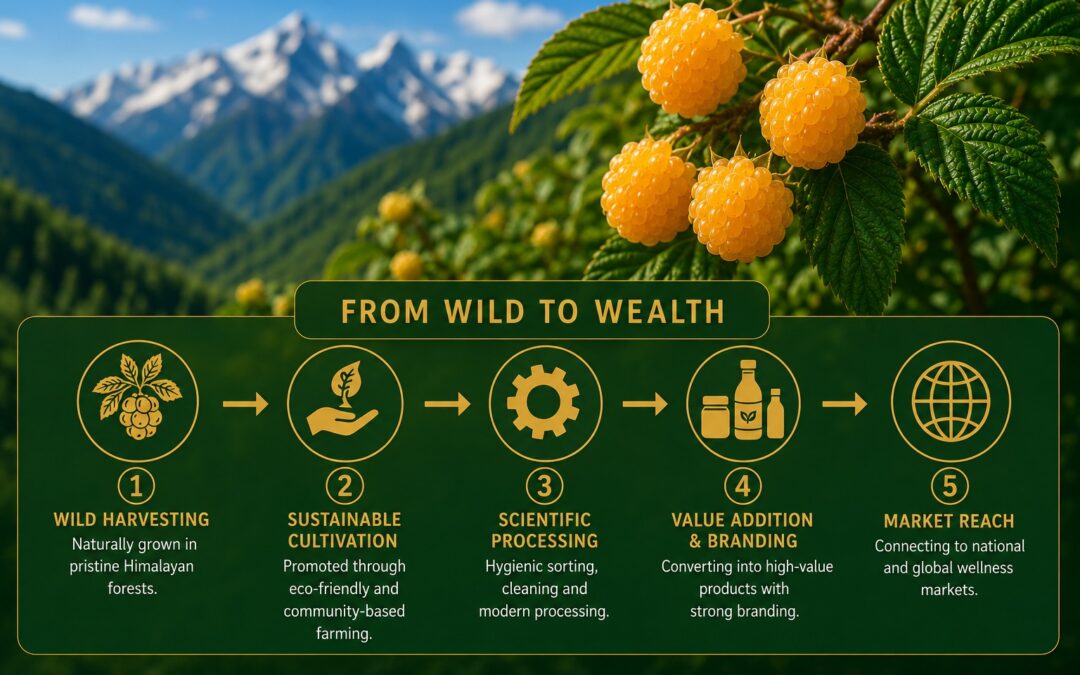
Yet today, much of this resource remains economically invisible, growing wild and perishing seasonally without organised harvesting, processing, or commercial integration. This is where scientific cultivation can become transformational. By transitioning Golden Himalayan Raspberry from unmanaged wild growth into scientifically supported agroforestry systems, tribal communities could create structured, recurring income streams.
Agronomic research can improve: yield consistency, fruit size, shelf stability, pest resistance, nutritional profiling, and post-harvest preservation. With proper intervention, local populations can move beyond opportunistic collection toward entrepreneurial bioresource management.
Equally critical is the development of downstream value chains. Raw berries alone rarely create lasting wealth. Real transformation lies in: processing units, freeze-drying facilities, nutraceutical extraction centres, cooperative packaging systems, branding and marketing ecosystems, e-commerce integration, and export certification frameworks. Products such as Golden Himalayan Raspberry concentrates, wellness teas, antioxidant capsules, organic jams, fermented beverages, and natural supplements could dramatically enhance product value while reducing perishability.
The socioeconomic implications are profound. Tribal communities in marginal geographies often face limited market access, low agricultural returns, and vulnerability to ecological or economic disruptions. Golden Himalayan Raspberry offers a rare opportunity to build prosperity around an already existing ecological asset, requiring relatively low entry barriers compared to large-scale industrial agriculture. If cooperative institutions or successful Farmer Producer Organisations (FPOs) were established specifically for wild Himalayan bioresources, they could aggregate production, ensure scientific quality control, negotiate fair pricing, and build national or international brands.
Such a model would not merely generate income; it could create a tribal bioeconomy revolution, where biodiversity conservation aligns with financial empowerment. Sustainable cultivation would encourage forest stewardship, reduce destructive land-use shifts, and incentivise preservation of mountain ecosystems. In this framework, conservation becomes commerce.
India stands at a pivotal moment where its vast but underutilised biodiversity can either remain neglected or be transformed into engines of inclusive development. Golden Himalayan Raspberry represents more than a fruit—it is a test case for how science, enterprise, ecological intelligence, and rural entrepreneurship can converge.
The next great agricultural revolution in India may not emerge solely from industrial monocultures, but from unlocking the value of forgotten wild resources already flourishing in its tribal landscapes through scientific research. Golden Himalayan Raspberry may well prove that one of the country’s sweetest pathways to rural transformation has been growing untended in its mountains all along.
— Dr Sanjay Kumar, Prof. Arun Tiwari