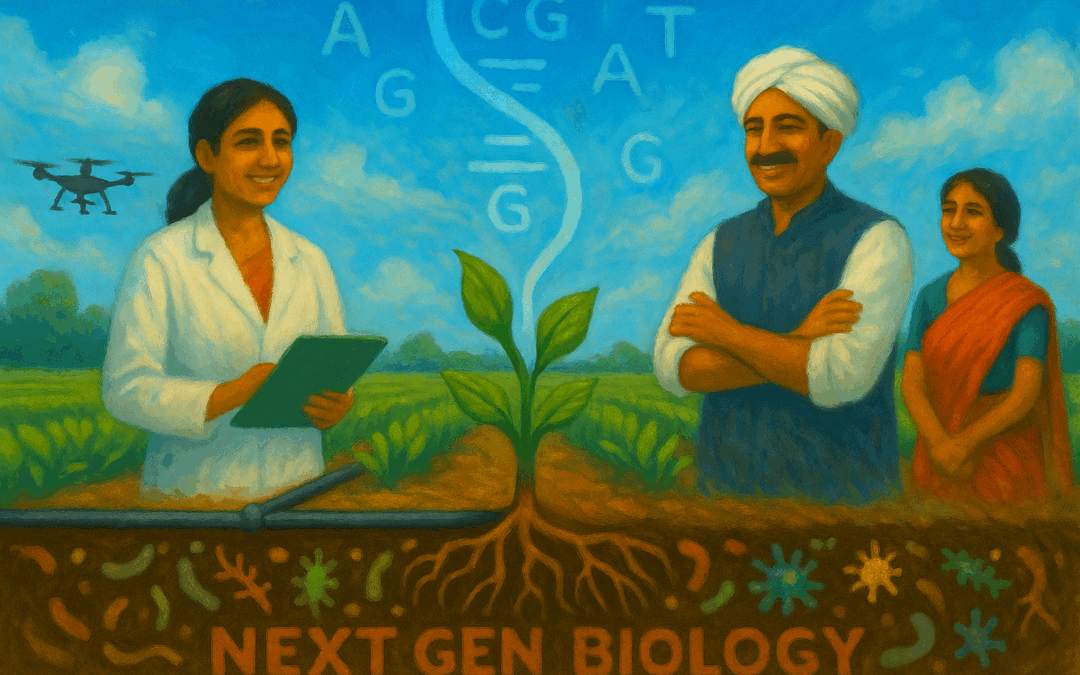
Next-gen biology marks a profound shift in humanity's relationship with the living world. For thousands of years, biology was primarily the art of observation: we watched seeds emerge from soil, traced the migrations of birds, and tried to understand why diseases spread. We named organisms, catalogued species, and studied nature with curiosity and caution. Biology was something external, something we observed from the outside. But today, it has transformed into a design discipline. Instead of simply watching life unfold, we are learning to shape it with intention. We can read genomes as if they were scripts and edit them with the precision of code. Tools like CRISPR and advanced genome-editing systems allow scientists to rewrite life’s operating manual in ways that would have seemed fantastical just a decade ago. In modern laboratories, biologists have become designers, composing new cellular functions like musicians arranging notes, tuning crops for nutrition, resilience, or climate adaptation with deliberate creativity instead of waiting for slow evolutionary chance.
One of the most remarkable frontiers of this new era lies beneath our feet. Soil, long dismissed as inert dirt, is actually a bustling metropolis of microbes: bacteria, fungi, archaea, and viruses that quietly run the nutrient economy of the planet. Next-gen biology has opened this invisible world to engineering. Scientists now design microbial consortia—custom communities of microorganisms that restore degraded soils, fix nitrogen naturally, suppress pathogens, enhance root growth, and increase water retention. These living blends work like precision ecosystems, offering the benefits of fertilisers and pesticides without the ecological costs. After decades of soil exhaustion from chemical overload, this return to biologically intelligent farming marks a significant turning point. Instead of forcing the earth to produce, we are collaborating with it.
Alongside microbes, a new generation of bio-inputs is rapidly replacing chemical agriculture. These are living or biologically derived solutions: biofertilizers that fix atmospheric nitrogen, biopesticides made from beneficial organisms, biostimulants that amplify photosynthesis, and RNA-based sprays that silence pest genes without harming other species. Such inputs align with natural systems rather than disrupting them, offering farmers a path to productivity that doesn’t poison water, degrade soil, or harm biodiversity. This shift from synthetic inputs to biological ones is more than a technical update. It signals a philosophical shift toward a more cooperative relationship with nature.
Nowhere is the creativity of next-gen biology more visible than in the development of climate-resilient crops. Scientists are crafting plants able to withstand heat waves, tolerate drought, grow in salty soils, resist emerging pests, and maintain yields under unpredictable weather patterns. These crops are developed through a fusion of gene editing, advanced breeding, and AI-driven predictive models. Modern labs often resemble artistic studios where life is sculpted trait by trait, with imagination and precision working side by side. Each breakthrough is a quiet miracle: rice that grows in brackish water, millets that thrive in drought, oilseeds that resist heat stress. In an era of climate instability, these innovations are not merely scientific achievements—they are lifelines.
Beyond fields and farms, synthetic biology is emerging as a new industrial force. Synbio treats cells like programmable factories capable of producing biofuels, bioplastics, edible proteins, medicinal molecules, biodegradable packaging, and carbon-absorbing materials. Microbes can now replace petroleum in manufacturing processes. Fungi can become leather alternatives. Algae can become energy systems. Plants can be tuned to synthesise vaccines or vitamins. This biological industrial revolution is cleaner, renewable, and far more aligned with ecological cycles than any fossil-fuel-driven industry of the past. It promises a world where materials are grown, not mined; where waste becomes feedstock; and where industry runs on biology instead of extraction.
A key reason this revolution is accelerating so quickly is the intelligence layer provided by artificial intelligence. AI predicts protein structures, optimises gene circuits, accelerates breeding cycles, maps soil microbiomes, and models the environmental performance of crops before they even sprout. With AI, biology moves from descriptive to computational. Designing a new trait is becoming as intuitive as sketching on a digital canvas. Farmers can receive real-time insights on soil health, irrigation, pest emergence, and climate risks. AI is to biology what a nervous system is to a body—an intelligence layer that makes the organism adaptive, responsive, and self-improving.
Taken together, these innovations signal a more profound transformation: life itself is becoming infrastructure. Biology is no longer only something to grow or harvest; it is something to build with. Soil becomes a living economy. Plants become data-rich organisms. Microbes become tiny engineers. Agriculture shifts from extractive to regenerative, from chemical-dependent to biology-powered, from high-input to high-intelligence. And farmers become stewards of designed ecosystems rather than operators of industrial machinery.
Next-gen biology represents more than a leap in scientific capability. It is the second sunrise of civilisation, a moment when humanity can align prosperity with planetary health. Instead of commanding nature, we can collaborate with it. Instead of degrading ecosystems, we can repair them. Instead of exhausting the soil, we can regenerate it. As the tools of life design mature, we enter an age where abundance can be created without harm, where imagination becomes a renewable resource, and where the biosphere becomes our partner—not our victim. The code of life is open, the possibilities are vast, and the future, if guided wisely, can be both resilient and regenerative.
For more on this, read Village Republic 2.0, available on Amazon.
https://www.amazon.in/Village-Republic-2-0-Sanjay-Kumar/dp/9349487160/
Sir
Well written on next generation biology, certainly it will add something significant for sustainable future. The blog article mentioned every thing about microorganisms, synthetic biology and its importance in future. Dr Sanjay Kumar sir is a renowned bio resources scientist having vast experience of more than 40 years in the sector. A person like him can describe about the sustainability of whole ecosystem for coming generations. He really felt the use of chemicals especially in agri-ecosystem which is playing a hazardous role for the life on the planet. He has given a wise solution through this important article. I wish you sir all the best and regards.